18 And Life To Go

One of my favorite songs when I was in college was “18 and Life to Go” by Skid Row.  That pop-metal song crashed back into my life as I traveled to Uganda this weekend for the 18th time.  My commitment to my beloved second country ensures that while this is trip 18, I do have “life to go” in my travels here.  But before discussing this upcoming week’s activities, here is a quick recap.

The Divine Collision book tour Henry and I started in late January ended in early March after a whirlwind spin through Texas involving three chapel talks at Baylor, a national radio interview, and three screenings of REMAND in Waco, Dallas, and Houston.  It was so good to catch up with dear friends along the way.

Breakfast in Dallas with Echols and Delaneys

Breakfast in Dallas with Echols and Delaneys

Prior to Henry’s departure, the BBC broadcast the radio interview Henry and I did with them and published an extensive feature on our story.  The Washington Post also published a nice article.  Following the BBC story, I received calls and e-mails from Nigeria, Ghana, the UK, and Uganda, some of which have raised intriguing new possible projects.

On March 3rd, Henry traveled back home to resume his medical school studies.  We loaded him up (down?) with lots of first-world “essentials” (developing world “luxuries”) for his family – frying pan, Tupperware, chocolates, etc.

We stopped at the beach in Malibu on the way to the airport for one last photo and said our emotional goodbyes as Henry boarded the plane for his 21st flight during the trip.  Memories to last a lifetime.

Farewell to Malibu

Farewell to Malibu


Heading Home to Uganda

I also sent Henry home with the near-final cut of REMAND – the documentary about how his case led to substantial reform in Uganda’s criminal justice system.  (Incidentally, the final cut will be shown on April 12th at the Historic Egyptian Theater for the first and only time prior to going on the film festival circuit – tickets available here.  Please pass along this invite to others).  Henry showed the documentary in his local village to a crowd assembled the night before he returned to medical school.

Prior to returning to Uganda, Henry had learned that he was among a list of approximately 200 of the then-remaining 360 students in his medical school class (which had started with 500 eighteen months ago) who had to re-take one or more of his examinations from the prior semester in order to advance to the second semester of his second year.  Henry was quite surprised that he had to retake Immunology, which he had believed was one of strongest subjects.

Upon returning to school, though, he discovered that he had not performed poorly on the exam, but instead that his was one of eighty students’ exams that had been lost by the professor.  All eighty had to take it again.  Soon thereafter, Henry was notified that he passed the retake and advanced to his fourth semester.

When all the dust settled on the third semester, only 280 of the original 500 students remained.  The “sifting” process will continue for a few more semesters, with the expectation being that around 200 will graduate at the end of six years.  Henry is quite confident he will be among them.

During this 18th trip, I will be nailing down the details of the upcoming summer prison project (June 17-27), finalizing a couple national conferences we will be hosting in late June/early July, arranging everything for this summer’s student intern class, and exploring new projects and expanding existing ones.

Before I left Malibu, I had my second call with a government official in Nigeria about potentially working with them on judicial reforms, and hosted a delegation of Guatemalan lawyers who are exploring possible criminal justice reform along the lines of those undertaken by Uganda.

Divine Collision continues to be received and reviewed well – thanks to those of you who have shared your thoughts on Amazon.  If you have had a chance to read the book, please let your voice be heard.  My publisher tells me that getting to 100 reviews on Amazon is an important benchmark.  As of today, we are nearly halfway there:)

Through New Eyes

During the four weeks Henry has been in the United States, I have learned to see daily life through new eyes.  It is so easy to take for granted many aspects of life in the developed world.  Henry was amazed by how good the roads were once he landed on January 26th – “they are all tarmac and almost no potholes.”  Equally confounding to him was the fact that drivers operated their cars in an “orderly fashion,” obeying traffic signals and staying in their lanes.  Having driven in Uganda during the six months I lived there in 2012, I knew what he meant about how different driving in both locations could be.

“Magic” is what he declared my garage door opener, and “Is the power always on?” is the question that soon followed.  Henry’s family first acquired electricity (one socket) in 2014, and continual flow of electricity is unusual.  One of the surprises he had was that there weren’t flying cars crowding the sky, as is supposed by many Ugandans living in the rural areas.

After Henry was released from prison in May of 2010, he enrolled in Bob Goff’s Restore Leadership Academy in Gulu, Uganda.  During his two years there, he got to know Bob fairly well due to Bob’s periodic visits.  Accordingly, our first outing on Henry’s second day was a trip to San Diego to see Bob.  As you can see from the photo, there is never a dull moment with Bob.

Of course Bob Goff has a ball pit in his office

Of course Bob Goff has a ball pit in his office

Also in San Diego, Henry got to experience the ocean for the first time, though it took some convincing that he wouldn’t be swept out to sea when the waves retreated.

IMG_2401

Soon thereafter, we visited the happiest place on earth, which is still Henry’s favorite place he has visited thus far.

Hey Disney, we have a story for you

Hey Disney, we have a story for you

Over the course of his first full week in Southern California, we did a live radio show, a screening of the REMAND documentary that features his story, and he attended school with Jessica at Pepperdine and with Joshua at Oaks Christian High School.  At each school, he was asked to address the classes about his medical school studies in Uganda and how stark the difference was in educational resources.  His favorite part of the school visits were the chances to use the microscopes, which are shared by ten students in Uganda.

Henry and I also had a chance to accompany Jessica to the juvenile prison where she volunteers as a tutor.  We told them our story about meeting each other when Henry was in prison in Uganda.  They initially refused to believe the conditions of Henry’s confinement as he shared with them the fact that he had no electricity, no running water, no flush toilets, and no bed.  Henry told them that if there were beds, electricity, running water, flush toilets, books, computers, teachers, and adults who cared about them, Ugandan kids would be committing crimes in order to be admitted to such prisons.

At Camp David Gonzales Juvenile Detention Center

At Camp David Gonzales Juvenile Detention Center

Our first adventure outside California was to Memphis, Tennessee, where we had the opportunity to speak to students at Harding Academy – arranged by JP and Jennifer Webber, who are good friends from our Abilene Christian days.

Harding Academy Chapel in Memphis

Harding Academy Chapel in Memphis

We also got a lengthy tour of the surgery center at the Toyos Eye Clinic, which is owned and operated by Rolando Toyos, a high school friend from my Santa Rosa days.  Unsurprisingly, Henry had never seen the kind of high-end equipment used for corrective eye surgery in the United States – Uganda has yet to take this technological leap.  Henry was quite intrigued by this area of medicine, but still remains committed to cardiology for now.

Toyos Eye Clinic in Memphis

Toyos Eye Clinic in Memphis

On the way from Memphis to Nashville, we pulled over in the snow for Henry’s first experience with frozen water falling from the sky.  Shortly after Henry had landed in LA, I asked him when he had been the coldest in his life.  “I have never been cold” was his answer because Uganda rests on the equator and never gets below about 70 degrees.  To prepare him for our travels, I walked him into the refrigerated area at Costco and told him where we were going was colder than this.  “Ahhh.  I will freeze to death,” he exclaimed.  Soon thereafter, we bought him the gloves and down jacket he wore during his first encounter with snow.

The next morning, while staying with our dear friends the Williamsons in Nashville, Henry had his first sled ride down a snow-covered hill.  Ten minutes later, he solemnly declared, “We must go inside now, as my hands are no longer functional.”  Henry was thrilled to meet the publishing team at Worthy for Divine Collision.

With Senior Members of Worthy Publishing Team

With Senior Members of Worthy Publishing Team

We also had the privilege in Nashville of sharing our story with elementary, middle school, and high school students at Lipscomb Academy, and with university students at Lipscomb University and Belmont University.

Lipscomb Academy (elementary)

Lipscomb Academy (elementary)

Lipscomb Academy Jr. High/High School

Lipscomb Academy Jr. High/High School

We also screened REMAND and met with multiple print media folks who are writing articles and book reviews about Divine Collision.

After a one-night return trip to Los Angeles in order to attend Pepperdine’s annual law school dinner, we got back on the road, this time with my wife Joline joining us.  Our first stop was in Norfolk, Virginia, where we were privileged to film two television shows for the Christian Broadcasting network, both of which were aired that day.  The links are here:

http://700clubinteractive.cbn.com/lawyer-defends-man-wrongfully-accused-murder-twice

http://www1.cbn.com/video/winning-a-fight-for-freedom-and-reform-in-uganda?show=700club

We then drove up to Washington, DC for a few days where we taped a BBC radio show that will air shortly around the world, screened REMAND at two different locations, and met with other members of the press.  We enjoyed the chance to catch up numerous dear friends who live in DC.  We also had a great behind-the-scenes tour of the US Supreme Court, and got to show Henry numerous important monuments.

Post-Screening Q & A in DC

Post-Screening Q & A in DC

We knocked, but no one was home

We knocked, but no one was home

At Supreme Court, with flags at half mast

At Supreme Court, with flags at half mast

Along the way, I recorded another radio interview with Faith Radio Network, linked here.

We concluded our East Coast tour with a one-hour live interview in the Empire State Building on the Eric Metaxas Show (Salem Radio in 200 markets) (podcast here), and a video interview with Guideposts Magazine, which will be publishing an article in May about our story.

With Eric Metaxas

With Eric Metaxas

At Guideposts HQ

At Guideposts HQ

A highlight of this visit was showing Henry the Statue of Liberty, which took on added significance as we stood together gazing upon this symbol of something Henry lacked for nearly two years.

This Monument took on new meaning as Henry and I gazed at it

The Statue of Liberty took on new meaning as we gazed at it

As I write this, we are on our way to Texas, where we will be appearing on a live radio show to 340 markets, speaking at three Baylor chapel sessions to a combined audience of more than 3,000 and showing REMAND in Waco, Dallas, and Houston.

So far, we are pleased and honored by the warm reception Divine Collision has received by both media and general audiences.  If you have read the book, we would be grateful for reviews on Amazon, Barnes & Noble, and elsewhere.


Touch Down

Pardon my Super Bowl metaphor, but I couldn’t resist.  Today feels like a touchdown, goal, grand slam, ace, slam dunk, and hole in one all wrapped up in a Chipotle burrito.  Henry lands in a couple hours for a five-week, six-state tour of the U.S. – the very day Divine Collision is officially released.
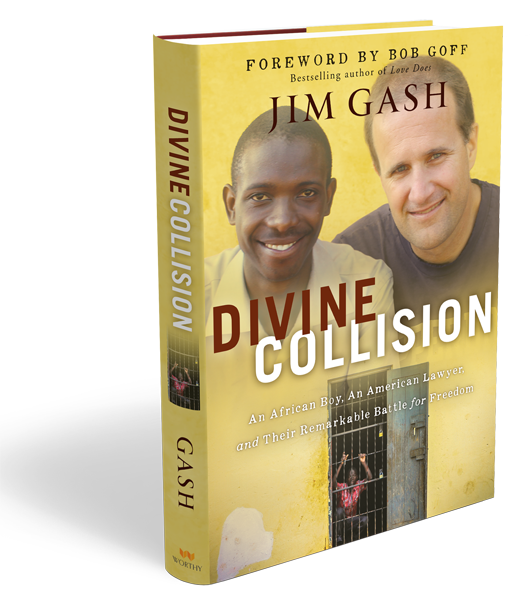
Divine Collision Book

As chronicled in Divine Collision, this day has been a long time in coming.  It was almost derailed more times than I have fingers and toes, including two weeks ago when his final exams were rescheduled to conflict with his trip.  Fortunately, Henry can be quite persuasive, and was able to convince the medical school dean to reinstate the original exam schedule so he could get on the plane.

On Monday morning, I spoke with him while he was on the way to the airport, and he was positively giddy.  He texted me from the runway just before departing from Entebbe (Uganda) for Amsterdam.  On Monday evening, he texted me from the security line at Amsterdam while he waited to board the final flight to Los Angeles.

We have numerous surprises in store for him, including a trip to the happiest place on earth.  He will be singing for his supper, though, as we will be appearing at numerous colleges, universities, high schools, churches, theaters, and bookstores along the way.

If you want to meet him (and get your book signed by him also), please feel encouraged to come to one or more of the events, including a potluck at my house this coming Sunday at noon.  Seriously, you should come.  (E-mail me for directions – jim.gash@pepperdine.edu).

I had a great trip to Waco, Abilene, and Lubbock earlier this month, and very much enjoyed the chance to speak with so many folks at these places.  I will always remember my first-ever book signing at Lubbock Christian.  More that event from the campus newspaper here.

Lubbock Christian Book Signing

And I certainly won’t ever forget the bat (yes, a bat) that circled ACU’s Moody Coliseum and dive-bombed me and the crowd of a couple thousand for the last eight minutes of my chapel talk.

We had a chance to screen REMAND at both LCU and ACU, and the press attended the ACU gathering.  More on that here and here.

I recently wrote an article for Relevant Magazine about how Bob Goff exploded my life – more on that here.

Also, I have had the privilege of talking to several folks in recorded podcasts/broadcasts.  The first was the Eric Metaxas Show, the second was with Dan Darling of the Ethics and Religious Liberty Commission of the Southern Baptist Convention, and the third was with Mike Schutt of the Christian Legal Society.

A few days later, I was invited to kick off Justice Week at Oaks Christian High School with a talk to the entire school, which is now on youtube here.

I will endeavor to chronicle on this blog, Facebook, Instagram, and Twitter Henry’s adventures around the country over the next five weeks.  Thanks for following along.

One final note – if you are planning to buy the book, I would be grateful if you did so in the next week or so, as initial sales figures are rather important.  Also, if you would be so kind as to provide a review of the book (once you have finished it) on Amazon, Barnes & Noble, and/or Goodreads, I would be much obliged, as my publisher tells me that the sooner we reach a critical mass on these, the better.

Visa?

Securing a visa allowing a non-citizen to visit the United States has historically been a challenge, particularly for those from the developing world.  This process has only become more difficult in the wake of the Paris and San Bernardino terrorist attacks.

The two most important decision-making factors utilized by the State Department are (i) whether the visa applicant presents a threat of danger to the United States, and (ii) whether the applicant presents a risk of overstaying the visa when the visa’s usually narrow time window closes.

We have been longing to bring Henry to the United States and would have flown him out here years ago if we didn’t think his, um, (wrongful) murder conviction, would have raised some teensy little questions about factor (i) above.  So we waited.  And waited.

After my agent and I selected Worthy as the publisher for Divine Collision in March of 2015, we targeted a publication date that we hoped would coincide with the typical three-week break between Henry’s medical school semesters at Kampala International University.  Those who have spent time in the developing world know, however, that forecasting dates into the future can be dicey.  This is no less true in the educational realm in Uganda.  Our best estimate was that Henry would finish the fall semester on or about February 6th, and then resume the spring semester on or about February 29th.

There was also the issue of the, um, conviction that still lingered.  Fortunately, our prayers were answered in June of 2015 when Henry was exonerated and his conviction was vacated.  That took care of factor (i).

Our next prayer was that we could persuade the State Department to issue Henry a visa for his three-week semester break.  (A little over three years ago, we got Henry a passport and sent him on a field trip to South Africa with his school so he could have at least a small track record of leaving Uganda and returning – that was his first (and only) plane flight).

After some discussion in the late spring of 2015, Worthy set the official release date for January 26, 2016, so we could ensure the book was out by the time he arrived in the event Henry was granted a visa.  About a month ago, Henry’s fall semester exam schedule was finally posted.  To our surprise, his last exam was scheduled for Saturday, January 23rd.  We also learned that the spring term would begin on Monday, March 7th.  Needless to say, this greatly expanded our potential window for his maiden voyage to the United States.

With the help of Pepperdine Law’s Uganda-based Nootbaar Fellow, Nicole Banister, Henry secured a visa interview for December 29th, just over a week ago.  At 1:00 a.m., Henry set out for Kampala on a crowded bus on bumpy road and made his way to Kampala at 5:00 a.m.  The lawyer who assisted me with Henry’s appeal, Edward Sekabanja, picked Henry up from the bus park and gave him a pep talk and some last-minute advice.

At 9:00 a.m., Henry and nine other visa applicants waited as they were called in, one by one, for their interviews.  When it was Henry’s turn, he straightened his tie, put on his suit coat, and confidently strode into the interview room carrying a folder of important documents – his completed visa application; a receipt showing he paid the interview fee; an invitation from me; a separate letter of support from me that explained the purpose of his visit and promised to ensure Henry would return to Uganda in time for the spring semester; a letter of support from Worthy describing the book and the book tour; a letter of support from Danny DeWalt, who serves as Honorary Consul to the United States on behalf of Uganda; admissions papers, exam schedules, and report cards from medical school; and his passport.  Edward had organized all of the paperwork in the right order.

After ensuring the application had been fully completed, the first question the friendly American asked Henry was, “So, why do you want to go to the United States?”

Henry had practiced his response: “I wrote a book with an American law professor and it is being published soon.”

The interviewer’s suspicions and eyebrows leapt up, even as his fingers dove down to his computer keyboard.  “Really?  What’s the name of the book?”

“Divine Collision.”

Henry’s heartbeat kept time with the interviewer’s rapid typing and clicking.

[Pause]

[Squint at the screen]

[Eye Dart to Henry]

“Hey, that’s you on the cover!  Cool!  Hey everyone, come look at this book this Ugandan student wrote with an American law professor.”  A half dozen other Americans in the Embassy crowded around the screen and congratulated Henry and asked him if they could order copies yet.  (Yes, wherever books are sold & Amazon is actually shipping in advance of the release date).  A few of them recognized Worthy and assured Henry that this was a really good publisher.

The interviewer quickly read through the paperwork, pausing only to call another part of the Embassy to verify that Pepperdine was indeed working closely with the Ugandan Judiciary.

“Congratulations, Henry.  You have been granted a visa!  Just come pick it up on Monday, January 5th at 3:00 p.m.”

Henry was ecstatic, but had to be careful around the other applicants, seven of whom were denied visas.  Needless to say, I was thrilled when he told me later that day.

“How long did they give you?”  I asked expectantly.

“Come again?”

“How much time are you permitted to be in the United States?”

“He didn’t say.  I told him my school schedule, but he didn’t say how long I could stay.”

So we waited.

On Monday, Henry picked up his visa and took a bus back to school to prepare for his final exams.  But before he left, he took a photo of the visa and texted it to me.

Henry's Visa!

Henry’s Visa!


I was stunned.  The effective dates are December 31, 2015 through December 28, 2017.  We were hoping for 4 weeks – he was given 104 weeks.

Henry will be arriving at LAX on January 26th, and departing on March 1st.  He is eager to meet many of you during his stay.  We will be in Virginia, DC, NY, Texas, Tennessee, California, and perhaps other states.  We will go to Disneyland, the beach, Chipotle, In ‘n Out, Chick Fil A, Cinnabon, and Baskin Robbins.  We will be on local, national, and international radio, national television, and at a university or theater near you.  Our tentative schedule is posted here, but it will be updated continuously.  Should be fun.

Speaking of radio, after two false alarms, I will finally be on the Eric Metaxas Show today – Wednesday, January 6th for a thirty-minute segment of his two-hour show.  It airs on over a hundred radio stations, but it is easiest to find on the show’s website here.  Just click the “Listen now” text bubble.  I haven’t yet been told when during the two-hour show I will be on, but I have been promised that the interview will air on Wednesday.  The Christian Post article I wrote that he asks me about is here.

More soon, and check out the rest of this re-designed website, including the new book trailer under the Divine Collision Book tab.

Collisions

After a productive summer project in four different Ugandan adult prisons, which was followed by an historic national plea bargaining conference in Kampala, the fall semester at Pepperdine Law began in earnest.  Because Divine Collision is officially being released in January, my teaching schedule was doubled up this fall so I could be more flexible to travel to book events in the spring.  This made the semester extra challenging, particularly in light of the week-long visit of a high-level delegation of Ugandan officials, the post-production and screening of the Remand film in November, and the final preparations for the book release.

In the summer of 2009, Dean Ken Starr traveled to Uganda to sign a Memorandum of Understanding (MOU) with the Ugandan Judiciary to formalize the partnership between Pepperdine and the Judiciary.

Dean Starr and CJ Odoki Signing MOU

Dean Starr and CJ Odoki Signing MOU

As the relationship broadened and deepened, however, it became clear that an updated MOU would be needed to reflect the breadth of our partnership.  So about six months ago, we began discussing the terms of a new MOU and the location where it would be executed.  Eventually, we decided to sign the agreement in Malibu so the newly appointed Chief Justice of Uganda could follow in the footsteps of the prior two Ugandan CJs with a visit to Pepperdine.  And whereas the original MOU was with the Judiciary, the expanded MOU would be with the Justice, Law, and Order Sector, which included all 18 justice institutions in the country.

Accordingly, eight of the top Ugandan justice officials flew to Los Angeles in late October for a one-week study tour on case management and to sign the new MOU.  The delegation included the Chief Justice, the Principal Judge (head of the High Court), the Chief Registrar and Secretary of the Judiciary (administrative heads of the justice system), the Solicitor General, the Director of Public Prosecutions (chief prosecutor), a Court of Appeals Justice, and the Secretary of the Plea Bargaining Task Force.  We met with the LA County District Attorney’s Office, the LA County Public Defender’s Office, the US Federal District Court, the US Court of Appeals for the Ninth Circuit, the Los Angeles Superior Court, the California Court of Appeals, and the California Supreme Court.

The MOU-signing ceremony was held in the law school’s Caruso Auditorium in front of a crowd of over 200.  Over the course of an hour, I interviewed each of the officials and we presented each other with mementos, prior to the official signing.  The entire event was captured on video has now been posted here.

MOU Ceremony

MOU Ceremony

Incidentally, that same week, Pepperdine kicked off the Parris Institute Distinguished speaker series by welcoming back to campus my classmate from 1993, Monty Moran, who serves as Chipotle Mexican Grill’s President and Co-CEO.  I interviewed him in front of another large crowd about how and why Chipotle has been such a success under his leadership.

With Chipotle's Monty Moran

With Chipotle’s Monty Moran

In November, the documentary film produced by Revolution Pictures was “preview screened” for the first time at Santa Monica’s historic Aero Theater before a crowd of about four hundred.

Aero Theater Marquee at Preview Screening

Aero Theater Marquee at Preview Screening

Cake with Henry's Photo in the frosting

Post-Screening Celebration Cake with Henry’s Photo Edible in the Frosting

Before the film, we had a Producer’s Dinner at the Santa Monica Loews Hotel, which featured a conversation with Baylor President Ken Starr, whose vision and overriding sense of justice gave rise to the Global Justice Program almost ten year ago.  I was privileged to join Ken on stage, along with an alum and two students who participated in the events depicted in the film as we were interviewed by Dean Tacha.

Producer's Dinner Panel with Ken Starr

Producer’s Dinner Panel with Ken Starr

Remand tells the story of how Pepperdine’s Global Justice Program has partnered with the Ugandans to bring needed change to the Ugandan criminal justice system.  The star of the film is Henry – the Ugandan boy featured in Divine Collision whom I met in a Ugandan juvenile prison nearly six years ago.  We were pleased with how well received the film was by the audience.

After the credits, Pepperdine film professor Craig Detweiler (who accompanied the film crew to Uganda both times) interviewed Revolution’s Randy Brewer, me, and a couple students in the film.  As the event was coming to a close, we Skyped in Henry from Uganda to the extreme delight of the crowd.

Henry on the Big Screen via Skype

Henry on the Big Screen via Skype

Over the past few months, the book publisher (Worthy Publishing) has been working with an awesome publicist to put together a marketing plan and speaking tour in conjunction with the book release.  This will begin in early January, but will pick up speed when Henry arrives in early February for three weeks between medical school terms.  We are currently scheduled to be in Texas, Virginia, DC, New York, and Los Angeles for speaking engagements, television and radio interviews, and film screenings.  Henry is quite excited about this upcoming trip to the United States – his first.

So far, the book reviews have quite favorable.  Bob Goff wrote a much-too-kind Forward and the book is endorsed by Ken Starr; IJM’s Gary Haugen; World Vision’s Rich Stearns; three Ugandan Justices; Amazima’s Katie Davis; Pulitzer Prize-winner Ed Larson; Olympic Gold Medalist Scott Hamilton; Federal Judge Edith Jones; Pepperdine, ACU, and LCU Presidents Andy Benton, Phil Schubert, and Tim Perrin; ESPN’s Roger Cossack; authors John Sowers, Jay Milbrandt, and Sara Hagerty; and several others.

The outside review we most eagerly anticipated was from Publisher’s Weekly, and we were thrilled with their write-up.  I am told it will be very important to book sales to have lots of pre-release sales and post-release reviews on Amazon once the book is released.  So, if you buy and read the book and are willing to write a review, I would be most grateful.

Here is another tip – pre-release, Amazon’s price fluctuates, and Amazon’s pre-release purchase policy guarantees the purchaser the lowest price between the dates purchase and actual shipping.  More on this here.  (Also, for purposes of sales statistics, purchases made on Amazon that include more than one unit only count as one unit sold.  So, if you feel compelled to buy more than one copy of the book, please buy them in separate transactions).

So, when will the book be available?  Soon.  Very soon.  While the official release date is January 26, 2016, the book has already been printed and will be shipped to online and brick-and-mortar retailers in ten days.  I am told that the online retailers will actually ship to customers before Christmas and that brick-and-mortar retailers will have it on their shelves no later than January 26th.  It will be in Barnes & Nobles, independent book stores, and Wal-Marts around the country beginning just after Christmas.

Since I am a huge fan of audio books, I was pleased when it was decided that Divine Collision would be recorded and available on amazon and audible.com by the official release date also.  I had a blast recording the difficult-to-pronounce words for the professional readers, and actually sitting in while Henry’s first-person parts were recorded in the studio by a former Shakespeare actor.

Recording Pronunciations at Studio

Recording Pronunciations at Studio

With Jason L. White, Reading Henry's Parts in Divine Collision

With Jason L. White, Reading Henry’s Parts in Divine Collision

The reader for the other parts will record in Nashville, so I will have to trust that he gets the pronunciations correct.

Henry continues to excel in medical school and is eager to meet many of you in about two months.

Advance

The fall semester started out in a full sprint and has only picked up speed over the course of the first four weeks.  The advance planning of our Parris Institute (named for its generous benefactors Rex and Carrol Parris) led to a smooth and inspirational launch week.  Bob Goff headlined the final day with a challenge to students live audaciously into the life God has for them.  Earlier in the week, I had a chance to address the incoming student on the topic of living and practicing law with character.  Still can’t get away from the sports analogies.

Baseball Bat


Gash helmetA few days later, in Uganda, Henry received another strong set of grades for his second semester of medical school.  He was one of only 200 of the original 500 who started the program to pass all of his classes and advance to the second year (of six).  Last week, he began the fall semester at Kampala International University and is taking Microbiology, Pharmacology, Biochemistry, and Anatomy & Physiology.  He is thrilled to be back in school.

He is even more excited about his upcoming visit to the United States this next February between semesters.  This three-week visit will roughly coincide with the release of Divine Collision – our book that tells the story about how our improbable meeting in a Ugandan juvenile prison in January of 2010 changed both of our lives permanently.  It was surreal receiving a couple boxes last month of what are called “Advance Reader Copies” of the book, which are given to potential endorsers prior to the official release of the book.

ARC

So far, I am humbled and honored to have endorsements from many of my heroes in both law practice and in faith, and several more are on the way (Ken Starr, Bob Goff (writing the Forward), Gary Haugen, Judge Edith Jones to name a few).  The hardcover version of the book is scheduled to be in bookstores around the country on January 26th, though I understand it may ship a few weeks earlier if ordered online where the book is currently available for pre-sale at Barnes & Noble, Amazon, and other online retailers.

It has also been quite fun to see the documentary film (Remand) near its completion.  We received from the Revolution Pictures a near final cut over the weekend and we will be doing some final editing before the first advance showing.  I am pleased to announce that the first “preview screening” of the film will be Saturday, November 21st at 7:30 p.m. at the Aero Theater in Santa Monica. Prior to the screening will be a Producers’ Dinner at Loew’s Hotel in Santa Monica, which will be headlined by the visionary for our Global Justice Program, Baylor President (and former Pepperdine Law Dean) Ken Starr, and the Executive Producer of the film, former Professor Janet Kerr.  The dinner program will also feature students and alums who lived the events depicted in the film.  At the preview screening, I will be joined in a Q & A by Director Andy Reale and one of the producers (Pepperdine Film Professor Craig Detweiler), as well as several students.  Tickets for both the screening and the dinner go on sale today at the event website.

The month before the preview screening of Remand, we will host a delegation of high ranking Ugandan officials for a one-week study tour, during which Pepperdine and the Ugandan Judiciary will formally sign an expansive Memorandum of Understanding charting the course for the future collaboration between our two institutions.  Among the delegation will be the Chief Justice of Uganda, the Principal Judge (head of the trial court), the Solicitor General, the Secretary of the Judiciary, the Director of Public Prosecutions, the Director of the First Parliamentary Counsel (chief legislative drafter for the country), Justice K (Pepperdine partnership liaison), and several others.  The signing ceremony will be at 12:30 p.m. on Wednesday, October 28th in the Caruso Auditorium in the law school, and will be preceded by “A Conversation with the Chief Justice of Uganda.”  All are invited to attend.

It’s A Wrap

One of the many ways in which Uganda’s court management structures differs from ours is in its heavy use of Registrars – lawyers who aren’t yet judges (but who will be in the future) exercise a fair number of judicial functions.  For example, the Criminal Court does most of its work in sessions – groups of forty cases that are scheduled for trial over the course of forty days.  The Registrar chooses which of the thousands of prisoners “on remand” will be “cause listed” for that next session.  A case being cause listed triggers the right to have an attorney appointed for those in the session.  The money allocated for the session (40,000,000 shillings, about 13K USD) is sent to the Registrar to administer.  1M goes to the judge, 500,000 to the Registrar, 250,000 each to the judge’s body guard and driver, about 10M to the lawyers for the forty defendants, etc.  Those who allege corruption occurs in the administration of justice often point to the relative trust placed in the Registrars when the session funds are released.

For nearly two years, there was no substantive Chief Registrar – the one supervising the various Registrars.  Vacancies in important roles litter the Ugandan judiciary, including in the Supreme Court (about five), Court of Appeals (about eight), and in the High Court (about thirty).  But last year – just before we began our prison pilot project, Paul Gadenya was moved into this position from his post as Chief Technical Advisor of the Justice, Law, and Order Sector (umbrella organization over eighteen different departments affecting law and justice (judiciary, prisons, police, prosecution, department of justice, etc.)).  As Chief Registrar, Paul basically runs the trial court system and is fourth in the official judicial hierarchy below the Chief Justice, Deputy Chief Justice, and Principal Judge, which is why we wanted to interview him for the documentary, so he could reflect back upon the progress toward implementation of plea bargaining that had been made since last summer.

As I knew he would be, Paul was terrific.  He is really smart, thoughtful, and well-spoken.  He doesn’t sugar coat the challenges Uganda faces, but remains optimistic about the future of his country and about its full-scale integration of plea bargaining.  He reported that since the Pepperdine prison project involving 160 cases at Luzira last summer, more than one thousand additional cases have been plea bargained by Ugandans, and the momentum is building to increase the pace.

After Paul, the crew filmed Andrew Khaukha, who works for both Paul and the Principal Judge to implement their vision of country-wide plea bargaining.  More than anyone, Andrew is making this happen with his dogged determination and strategic planning.  His will be an important voice in the film.

After we watched the rough cut of the documentary that was prepared after last summer’s filming, it became clear that the last chapter of the story was missing.  There needed to be an answer to the question raised by several of our students – sure, we interviewed 160 prisoners and prepared case summaries, but what would happen after we left?  Would these prisoners really get the access to justice they sought?  Would there be any lasting change?

These questions were partially answered by the interviews we captured in which the talking heads told us how much difference we had made, but what wanted even more than these answers were stories of real prisoners who had benefited.

So from the High Court, we returned to the Luzira prison complex where most of last summer’s filming took place.  This complex houses Luzira Upper, which is the maximum security prison, Murchison Bay, the medium security prison, and Luzira Women’s, where about four hundred women are on remand or serving out their sentences for violent crimes.  Last summer, we prepared 160 combined cases from all three prisons, though we filmed exclusively at the maximum security prison.

During my prior visit to Uganda about three months ago, I had attended a consensus-building workshop at which the latest draft of the plea bargaining practice directions (guidelines) were being discussed.  At this meeting, one of the prisoners from Murchison Bay named Rashid had been asked to speak about what plea bargaining meant to him the other prisoners.  I had been blown away by the clarity with which he articulated the reasons he and his fellow inmates benefited from plea bargaining – reasons that went well beyond the fact that he received a shorter sentence than he feared if had gone to trial.  He explained that the uncertainty of not knowing when, if ever, he would go to court, not knowing when, if ever, he would get a lawyer, and not knowing when, if ever, he would be released was crippling him and his fellow inmates socially, psychologically, and spiritually.

When he was finished speaking at that workshop, I knew we needed to interview him for the film.  With Andrew’s assistance, we secured permission to go to Murchison Bay to ask the warden if we could interview Rashid for our film.  Fortunately, the warden (Savestino) had been with me in Louisiana two months ago for a study tour of best practices in moral rehabilitation.  He was also eager for plea bargaining to continue because he saw firsthand the positive impact on prison morale, so he readily agreed to allow us to interview Rashid.

Because Rashid had read from a prepared text a few months ago, I wasn’t sure how well he would be able to tell his story without reading it.  When they brought him to the warden’s office, his eyes lit up when he saw me.  When I introduced myself, he smiled and said, “I know who you are – you came here to tell us about plea bargaining more than a year ago before the team of lawyers came last year.  I also saw you at the conference at the country club.”  That was a good sign.  I told him we wanted to ask him some questions and I asked him if he still had his notes from when he spoke.  He again smiled and said in perfect English, “I have it all in my head – I can talk about it all day long.”

The interview went exceptionally well.  He nailed every question and explained that he is so excited to be reunited with his daughter on March 23, 2019 – he is counting the days now that he has a release date.

Rashid embracing his future (Photo by Rob Hauer)

Rashid embracing his future (Photo by Rob Hauer)

Andrew had also told us that two women we had interviewed at Luzira Women’s Prison had been released during the last year.  Both had been resettled to Mubende, about three hours from Kampala.  Our hope on Friday was to track down one or both of them so they could tell their story of how the plea bargaining program set them free.  But in order to do this, we needed to capture a slice of life in the women’s prison, which we didn’t have time to get last time, in order to set up the contrast.  So we got permission from the warden there and filmed about an hour of daily life at this prison.  As we were about to leave, we heard some faint singing coming from one of the cell blocks, so we went to investigate.  Ten minutes later, we were in the middle of the cell block surrounding by fifty jubilant women dancing, playing plastic drums (using a bucket), and singing their hearts out about their Savior who rescues them.  We recorded for about fifteen minutes, then shifted to the next cell block over who wanted us to record them singing.  We now have a soundtrack for the film that is causing me to tear up just writing this as I remember the passion and joy in their eyes and their voices.

Thursday night, I had dinner at my favorite restaurant with our Pepperdine students, who were finishing their summer internships the next day, and our Nootbaar Fellows, who will be in Uganda for another few months.  (Earlier that day, I had another productive meeting at the US Embassy about possible funding for some of the projects we are working on).

Farewell dinner with the Pepperdine Interns

Farewell dinner with the Pepperdine Interns

On Friday morning, we completed our final interview, which was of the Principal Judge, who is the Chair of the Plea Bargaining Task Force, and the architect of the nation-wide roll-out of plea bargaining.  As always, he was clear and determined, and grateful for the partnership between our institutions.

At about ten, we set out in search of the two women who had been released.  By four, it was clear we wouldn’t find them, even with the help of a local prison officer.  We did get the phone number of one of them, who told Andrew that she had relocated to Wakiso, about forty-five minutes outside of Kampala.  We decided to reload and renew our search on Saturday morning, but time was running short, as we were set to fly home Saturday evening.

At 1:00 a.m. Saturday morning, Henry arrived into Kampala after finishing his final examination of his first year of medical school that afternoon in Ishaka – six hours away.  We chatted for a few minutes before catching a few hours of sleep in advance of setting out for a second day of searching for the released prisoner.

By 10:00 a.m., we had found her.  She was thrilled to see Andrew, whom she remembered from his many trips to the prison informing her and her fellow inmates about plea bargaining.  Since being released from prison, after spending four years on remand, she had been “born again” and was serving as an associate pastor for her village church.  She was also reunited with her nine-year old daughter, from whom she had been estranged prior to being arrested for her minor involvement in a mob killing of a thief.  During the plea bargaining program, she had pled guilty to manslaughter (she hit the deceased with a stick after a group of male villagers had beaten him thoroughly – he died a few days later), and was sentenced to time served.  Needless to say, she was thrilled to be out and living a new life.

Christine telling her story (Photo by Rob Hauer)

Christine telling her story (Photo by Rob Hauer)

After the on-camera interview, we found out what her monthly rent was and paid three months’ worth.  She was exuberant and sang a song, along with a few others as back-up, called “Webale Jesu” – Thank You, Jesus (for Redeeming Me).  Her voice was almost as beautiful as the lyrics.  It was a rather emotional moment, to say the least.  My prediction is that the film will end with her singing this song.

Webalu Jesu

Webale Jesu

Following Christine’s interview, we drove to the Wentz Medical Clinic where my family assisted the Gregstons (our Twin Family) in 2012, and where my two youngest helped a few weeks ago.  The crew shot some “B-roll” of Henry walking around in his lab coat to show that Henry is now entering the clinical stages of his medical training.  When we finished filming last summer, Henry’s goal to attend medical school was just a dream, so capturing him a year later as an actual student closes the loop in a very uplifting way.

Just before we left, Michelle Abnet (Revolution Pictures Producer) had the idea of taking a couple pictures with the wood carvings I commissioned when I arrived in Uganda three weeks ago, and had received back the night before.

"Remand" is the title of the documentary.

“Remand” is the title of the documentary.

It was so great to spend the day with Henry again, and to be able to celebrate in person his exoneration on all charges that had been pending for over five years.  Our dear friends, Colin and Amy Batchelor, had sent with me some money to allow Henry to have a proper celebratory party with his family on Saturday night, which is the first time he will have seen them since we received the favorable ruling three weeks ago.

Thanks for following along.  My final edits on the book (“Divine Collision”) are due in about a week, and the publication date has been set for January 26, 2016.

Earlier Than Immediately

One of my greatest regrets over the five years I’ve been coming to Uganda is that I haven’t visited the US Embassy in Kampala more often to keep them updated on what Pepperdine is doing in Uganda.  During my first trip, in January of 2010, our group met with Ambassador Jerry Lanier shortly after we arrived.  I will always remember what he said: “During your stay in Uganda, you will learn more about the United States than you will about Uganda.”

He was right.

It is easy to take for granted all that we have in the United States that Uganda lacks – reliable electricity, easy access to clean water, navigable roads, consistent internet and phone signals, a responsive public justice system, etc.  It is only when one experiences their absence does one truly appreciate their presence.

During my last trip to Uganda in April of this year – my sixteenth – I visited the Embassy for only the second time in five years.  This past Monday, I returned to the Embassy for the third time and brought with me the presenters for the National Plea Bargaining Conference – judges Beverly Reid O’Connell and Tricia Bigelow, public defenders Melissa Mertens and Lisa Brackelmanns, federal prosecutor John Cotton Richmond, former prosecutors Alan Jackson and Will Lathrop, OU law professor Michael Scaperlanda, American lawyer practicing in Zambia Sara Larios, and Global Justice Program Coordinator Jenna Anderson.

Our counterparts for this meeting at the Embassy were two United States political officers and a Makerere University Law Professor who provides valuable local insight and guidance for the Embassy.  Our meeting lasted about 90 minutes and mostly involved us briefing them about what Pepperdine has been doing with and in Uganda for the past eight years, and one of the Embassy’s political officers expressing his frustration and skepticism about the prospects of immediate changes in the political/judicial structure of the country due to endemic corruption.  (Not two days later, the President’s two main opponents in the upcoming February, 2016 election, were both arrested the same day on their way to separate political rallies under the Public Order Management Act, which one of these opponents championed and employed while recently serving as the Prime Minister of Uganda).  I, of course, understood the political officer’s perspective, but have a decidedly more favorable view of the future of the judiciary.

At the end of the meeting, the Embassy representatives offered to put me in touch with their colleagues at the USAID portion of the Embassy, which is the arm that funds various projects aimed at assisting Uganda in improving its economy, health, and justice system, among other sectors.

Our team spent the next few hours on Monday finalizing preparation for the next day’s conference, and then we all (including our students, but less a portion of our prison project group who flew home on Sunday evening) attended a dinner at our hotel hosted by the Principal Judge of Uganda.

The national conference kicked off the next morning only about forty minutes late, which is early for Uganda conferences.  The Director of Public Prosecutions, Mike Chibita, opened the conference with a speech about how and why plea bargaining will assist in delivering the rule of law to Uganda, and how important Pepperdine’s partnership is to this enterprise.  He was followed by Matt Bunt from the US Embassy, then Principal Judge Bamwine.

Conference just before kick off

Conference just before kick off

Principal Judge Bamwine in his opening remarks

Principal Judge Bamwine in his opening remarks

Finally, newly appointed Chief Justice Bart Katureebe officially opened the conference.  He thanked those in attendance, gave his strong blessing to the rapid and wide-spread adoption of plea bargaining, and pledged to deepen and expand the relationship between the Judiciary and Pepperdine through his visit to Malibu this fall.

After nearly a year of planning, it was go time.

I took the microphone, provided a brief history of Pepperdine’s relationship with Uganda to the 150+ judges, prosecutors, defense lawyers, and other government officials in attendance, and then introduced the team.  I gave an overview of the conference itinerary and then ceded the microphone to Melissa Mertens, who acted as the narrator for each scene of the seven-part re-enactment of the plea bargaining process, covering arrest through sentencing.

After each scene, I would retake the microphone and walk the crowd through what they observed and what they should learn from each scene.  I did this by calling on select members of our team to explain what had just happened and why, and then I would try to put this into the context of the Ugandan criminal justice system with which I have now had substantial experience.  Before we transitioned to the next scene, Lisa Brackelmanns would explain how and why things would be different if the defendant were a juvenile.

Scene one of our simulation opened in the prosecutor’s office with the police officer presenting his report to the prosecutor (our hypothetical case was based upon one we encountered the prior week and involved the killing of one neighbor by another over a land boundary dispute), allowing the prosecutor to decide what charges to file.  IJM Gulu Field Office Director, Will Lathrop, played the role of the police officer and John Richmond played the prosecutor.  This report was completed within 48 hours of arrest so the suspect could be arraigned within that time period.  In Uganda, police reports are usually completed several weeks or months after arrest while the suspect waits in jail.

Scene two began in the courtroom when the defendant was informed of the charges against him and assigned a lawyer to represent him.  Judge O’Connell played the role of the judge – decked out in the Ugandan wig and red robe – John Richmond continued his role as prosecutor, Alan Jackson played the defense lawyer, and one of our students (Costa) played the defendant.  In Uganda, the defendant is not provided a lawyer until just before trial (up to five years after arrest), rather than during the initial court appearance within 48 hours of arrest, as is the case in our public defender system.  We must have encouraged them to adopt such a system on twenty different occasions during the conference.  Indeed, there is a bill that has been languishing in Parliament for three years that would do just that.

Scene three took place back in the prison where the defense lawyer met with the defendant to explain the evidence against the defendant that the prosecution provided to the defense lawyer within a few days of arrest.  During this scene, the defense lawyer also presented the defendant with the prosecution’s plea offer in this case (18 years on the hypothetical murder charge).  In Uganda, the defendant is entitled to the evidence against him, but there is no specificity of when and what type of evidence.  And since the defendant doesn’t get a lawyer until just before trial, these “disclosures” rarely occur until then because there is no one to whom the evidence could be given.  Likewise, because the defendant rarely has a lawyer, the prosecution can’t begin plea negotiations because there is no one to bargain with.

Scene four occurred in the prosecutor’s office where the defense lawyer explained to the prosecution the weaknesses in its case, raised the defenses that would be asserted at trial, and offered (in accordance with the wishes of his client) a plea offer of ten years on charges of manslaughter, reduced from murder.  After a back and forth, the prosecution agreed to the manslaughter, but only if the sentence term was twelve years.

Scene five took place back at the prison where the defense lawyer talked through the prosecution’s counter to the defendant’s counter-offer with the defendant and explained that the two years the defendant had been “on remand” would be credited year for year, thus reducing the 12 years to 10 more, if the deal was accepted.  The defendant accepted the offer.

In scene six, the lawyers met in the judge’s chambers and informed her they had reached a plea agreement and what it entailed.  The judge asked a few broad questions about the case, and then told the counsel to go out into open court where the agreement would be memorialized on the record.

Finally, the setting for the scene seven was in open court where, before taking the plea and entering the sentence, the judge invited the surviving spouse in our murder scenario to present a victim impact statement.  The role of the grieving widow was played by our own Justice Bigelow who, while dressed in a traditional Ugandan dress and head scarf, provided a moving and entertaining monologue about how much she misses her husband, and how much the defendant should pay for his crime.

Justice Bigelow providing Oscar Worthy performance as Judge "O'Connell" looks on

Justice Bigelow providing Oscar-worthy performance as Judge O’Connell looks on

Judge O’Connell thanked her for her testimony, took the defendant’s guilty plea, and then sentenced him to the twelve years (minus the two served) that had been agreed upon.

Over the next hour, I moderated a lively Q and A session.

Gettin' worked up

Gettin’ worked up

After lunch, we divided the attendees into small groups, each consisting of a High Court Judge, a prosecutor, and a few other lawyers to represent the accused.  We assigned them a fact pattern based upon a case we had encountered the week before and turned them loose in various parts of the hotel to see if they could negotiate a deal and present it to their assigned judge.  They got so into the exercise that it took us an extra half hour to get them to come out of their groups to report their results.

We closed with a little more Q and A, and an excellent speech by Justice Kiryabwire, who is the Ugandan liaison to the Pepperdine/Uganda Memorandum of Understanding.  In preparing for his speech, he had pulled from his files the original memorandum written by our two students (Greer Illingworth and Micheline Zamora) urging Uganda to consider plea bargaining.  Providentially, it had been written exactly seven years earlier, to the day – July 7, 2008.

Before we departed, our Ugandan friends presented us with some gifts, including Uganda Cranes soccer jerseys.  More about the conference was reported locally here.

Later that night, we had dinner with a group of judges and other government officials who have visited Pepperdine – a number that has now swelled to nearly thirty.

Justice Bigelow and Judge O'Connell with Former CJ Odoki and Justice K

Justice Bigelow and Judge O’Connell with Former CJ Odoki and Justice K at post-conference dinner

The next morning, the film crew interviewed the Solicitor General of Uganda, and the Commissioner General of Prisons.

"Earlier than Immediately"

“Earlier than Immediately”

In the latter’s interview, he stressed that plea bargaining needs to be fully implemented throughout the country right away – in his words, this needs to happen “earlier than immediately.”

In the afternoon, the conference team had one last meeting with the top brass at the prosecutor’s office to answer follow-up questions after the conference.  That night, everyone except me and the film crew flew home.  We still had three more days of filming to do in order to wrap up the documentary.

What we captured over the next three days far exceeded our hopes.

I, The Dung Beetle

I find myself in an increasingly familiar location as I write this long-overdue update on our team’s Ugandan prison project and plea bargaining conference – in the KLM Lounge in Amsterdam.  Nineteen days have blown by, and I have only had the time to summarize the first eight days.  Where I left off on Thursday, July 2nd, we had just completed four days of case preparation in three prisons – Mbale, Tororo, and Soroti – all in Eastern Uganda.  In the Mbale prison, more than 75% of the prisoners were “on remand” – waiting for something to happen.  No lawyer, no court date, no sense of the evidence against them, and dwindling hope.

Friday the 3rd started very early (again), as our group of about thirty-five American lawyers, Pepperdine law students, Uganda Christian University students, drivers, and armed body guards piled into a bus, a van, and a truck for the two-hour drive from Soroti to Lira.  As in the other cities, our morning began at the courthouse where the resident judge in this district hosted a ceremonial launch of our work at the prison.  We always closed these ceremonies with a prayer, usually led by one of our students or lawyers.

From the courthouse, we headed to the prison and broke into our groups, each consisting of a Ugandan lawyer (from the local practicing bar), an American lawyer, a Pepperdine student, and a UCU student.

Insert your own clever quip here . . .

Insert your own clever quip here . . .

As usual, we had the case file of evidence against some of the defendants we interviewed, and only a flimsy conclusory indictment for others.  Also as usual, Tennessee prosecutor Emily Smith (’10) and former LA prosecutor Alan Jackson (’94) broke off in the late morning for some focused training of the local Ugandan prosecutors.

Around 1:00 p.m., we paused for the typical Ugandan lunch of matooke, ground nut sauce, rice, anemic chicken, spongy beef, and assorted vegetables.  (This same fare was served each evening at our hotel also).   By the end of the week, the American lawyers were eager for something that looked and tasted familiar, or . . . not so familiar).

As was also our custom, in the mid-afternoon, a group of us broke off from the others to re-enact four stages of the plea bargaining process for the judges, magistrates, prosecutors, and defense lawyers in town, which was followed by a spirited question and answer session.  On each occasion, the entire group unequivocally embraced the plea bargaining program that they now understood and could apply.  We always left encouraged.

That evening, we continued our tradition of hosting a dinner at our hotel for the judges, magistrates, prosecutors, and defense lawyers so that the conversation and relationship building could continue.  By the end of the night, we were exhausted, but quite satisfied that we had accomplished our goals.

As we were heading to bed in Lira on Friday night, the second wave of team members were arriving in Kampala.  Federal District Court Judge Beverly Reid O’Connell and California Appellate Justice Tricia Bigelow were given special treatment at the airport – pulled into the VIP lounge and then given a police escort, complete with sirens and honking that parted the gridlocked traffic, reducing the two-hour drive to just over thirty minutes.

A little while later, John Cotton Richmond (US DOJ Human Trafficking Prosecutor) arrived with the film crew, who returned to Uganda to finish the documentary called “Remand” that began last summer.  That crew also received a police escort back to the hotel, which differed greatly from last year’s three-hour detention at the airport.

On Saturday morning, both groups set out from their respective destinations for Murchison Falls National Park for a celebratory 24 hours at the Paraa Safari Lodge.  This weekend served as an appropriate transition point from the intensive and gritty prison work to the philosophical and relational work with the policy makers, high level implementers, and funding sources for the expansion of plea bargaining to the entire country.

After checking into the spacious, western lodge, we hustled the quarter mile down to the Nile River to climb aboard a double-decker river boat for the three-mile cruise to the base of Murchison Falls.  While this was my third such cruise, the first timers were enthralled to be floating on the same river Moses traveled in a basket in Egypt so long ago.  We saw hundreds of hippos and water buffaloes, scores of rare birds, a handful of crocodiles, and soaked in the grandeur of God’s creation.

Murchison Falls

Murchison Falls

Murchison Hippo Resized

That evening, the team of presenters gathered over dinner to finalize the agenda for Tuesday’s national conference.  Over the course of the week, our plans had evolved away from the “Sage at the Stage” idea of presenting PowerPoints and gravitated toward a full-blown re-enactment of how the plea bargaining process works from arrest through sentencing, supplemented by robust discussion between each scene.

We awoke early Sunday morning for a game drive throughout the park in four safari vehicles.

Prison Project-1938

Lion Cub in a Tree

Lion Cub in a Tree

While the lions, elephants, giraffes, and antelope were great to see, my favorite encounter was with a dung beetle.

I, The Dung Beetle

I, The Dung Beetle

This little guy worked slavishly for hours (days?) to shape a perfectly round ball of animal excrement about twenty times his size.  His mate then clamped onto the dung ball and went for a ride.  The male pushes the dung along the road until he finds to a place where the female can lay her eggs inside the dung ball where they can grow, the dung providing the nutrients needed.  As we watched, this male beetle rolled his ball of dung for about three minutes until he got to a place he wanted to go.  He then flipped upside down and pushed with his hind legs as the ball slowly moved up the lip of the road, only to shift slightly and then roll back down.  Again and again he tried, only to be met with the same fate.  Eventually, we left in search of other wildlife.  I choose to believe that all of his effort eventually paid off and he was successful in fully accomplishing his task.

While (thankfully) not a perfect analogy, I identify with this little guy as he pushes and pushes, trying to get to the right place with the right people coming along so that the task can be accomplished.  Too many times I have felt the ball rolling back downhill.  As will be clear in my next post, however, I have no doubt that the ball has rolled up and over the barrier and we are now reaping the fruits of our labors.

Giving Birth

The idea of adopting a system of plea bargaining in order to expedite the criminal justice process for those arrested and detained in Uganda was conceived seven years ago during the summer internship of two Pepperdine law students – Greer Illingworth and Micheline Zamora.  The birthing process has been slow, but steady, during the gestation period.  We assisted with the rollout in the juvenile realm in recent years, and with several pilot programs in the adult realm.

This week, it truly feels like the delivery is nearly complete as our team of two dozen lawyers (mostly Pepperdine alums) and Pepperdine law students work hand in hand with Ugandan law students and lawyers to bring access to justice for about 150 Ugandan prisoners.

We started out on Monday in Mbale, a rural city in Eastern Uganda near the border with Kenya.  After a small ceremony at the Mbale High Court presided over by the two High Court judges resident in Mbale, we drove out to the prison to meet the thirty prisoners who indicated a desire to negotiate a plea deal in exchange for a guilty plea.  We assembled into our seven pre-assigned teams, each consisting of at least one American lawyer, one Pepperdine law student, and one Uganda Christian University law student, and waited for the Ugandan lawyers to arrive.

And waited.

The Ugandans are wonderfully friendly and welcoming people, but they are not burdened by the virtue of promptness.  About an hour later, one arrived.  And then another.  Fully two hours after we were supposed to begin, each group finally had a lawyer.  Over the course of about 60-90 minutes each, the team interviewed the prisoners, explained to them the concept of plea bargaining, and discussed whether the prisoner was interested in accepting the prosecutor’s offers that had been communicated that morning.

Over the next six hours, the team got through their thirty cases.  My role was to direct traffic, answer questions, and liaise with our Ugandan judiciary counterparts, chief among them is Andrew Khaukha, without whom this bus wouldn’t be rolling forward.  By the end of the day, another twenty or so prisoners had come forward wanting to engage in plea negotiations.  That night, the students and lawyers worked quite late into the evening summarizing their interviews.

Allison Brown — junior at Abilene Christian University, daughter of team member Alan Brown, and overall project MVP — helped Jenna Anderson (works with me at Pepperdine) manage the case files (both physical and digital), and captured in pictures much of what we were doing.

Alan Brown and his team

Alan Brown and his team

Emily Smith and her team

Emily Smith and her team

Melissa Mertens with a prison guard

Melissa Mertens with a prison guard

OU Professor Michael Scaperlanda and his team

OU Professor Michael Scaperlanda and his team

Huddling up with Alan Jackson

Huddling up with Alan Jackson

Directing Traffic

Directing Traffic

On Tuesday, we engaged in the same process at the Tororo prison, which is about one hour outside of Mbale.  The Ugandan lawyers weren’t quite as late, but only three of the promised seven showed up.  This meant that we needed to proceed with the case preparations in their absence and then connect the clients with their lawyers after the interviews were completed.  Once again, numerous other prisoners joined in the process as the day progressed.  For the first time in our series of pilot programs over the years, we actually executed plea agreements on the spot in the prison.  This marked a huge step forward in the Ugandans’ embracing of plea bargaining practice, in addition to theory.  This was followed by another late night of case preparation.

Wednesday morning had us back in the Mbale prison because there were so many new additions to the project.  Fully 75% of the 450 inmates at the Mbale prison are “on remand,” which means they are incarcerated while they wait for a court date to be scheduled, which is the trigger for an assignment of a lawyer.  Some wait five years or more for this to happen.  They are tired of waiting.

In the afternoon, we returned to the Ugandan High Court trial courtroom for a training program for the Ugandan judges and lawyers.  This consisted of a re-enactment of the plea bargaining process from start to finish.  LA Public Defender, Melissa Mertens, played the role of narrator and court clerk.  Tennessee prosecutor, Emily Smith, played the role of prosecutor.  Former LA district attorney/now private defense lawyer, Alan Jackson, played the role of defense lawyer.  Midland, Texas-based oil and gas lawyer, Alan Brown, played the role of a criminal defendant who had been charged with murder.  And yours truly played the role of judge.

The re-enactment started in the prison as the two Alans discussed the case, including the prosecutor’s offer.  It then moved into the prosecutor’s offer where an agreement was reached.  From there we moved into the judge’s chambers for an informal discussion, finally finishing by taking the plea on the record in open court.  This was followed by an extensive Q and A.  The feedback we received was quite favorable.

After this role-playing re-enactment, we spent a heartbreaking hour visiting the Mbale juvenile remand home.  I had worked in four remand homes in the past, including this one, but most others hadn’t experienced the desperate conditions endured by juvenile prisoners.  While this was mostly a social visit, we were able to assure them that their cases would be added to the next court session a few weeks from now.  As we left, we pitched in enough money to allow the staff to provide them with a big feast the following day, breaking the drudgery of corn meal and beans that they have every day.

Mbale Remand Home

Mbale Remand Home

Thursday morning, we left Mbale at 6:30 a.m. to travel farther north to Soroti, where we spent the day at the Soroti prison doing the same thing as the prior days.  Fortunately, word is traveling well, so we had nine Ugandan lawyers meet us at the prison, and most arrived within an hour of the scheduled start time.  We also conducted another simulated plea bargaining session at the High Court building in the afternoon, and all twenty-five of the lawyers in town attended and engaged in an exceptionally encouraging question and answer session after we finished.

From the High Court, we headed back to the prison to finalize some tasks and to take a group photo.  As we were leaving and about to board our bus, two prisoners assisted a cow in giving birth – right there in front of us – to a baby calf.

The symbolism was lost on no one.

As I write this at 11:00 p.m., half of the team is hard at work finishing their case summaries from today and preparing for our visit to the Lira prison, even farther north.