Aiming for Superfluous

Our Global Justice Program’s goal for our work in the developing world has been, is, and always will be to educate, equip, and empower our friends to create, implement, and sustain the needed reforms to their justice system themselves.  In a very real sense, we seek to become superfluous.

Measurable progress rarely comes easily or quickly.  But when it comes, there is little that is more gratifying.

Within the past week, I received three separate confirmations that brought profound satisfaction.  The first was in an e-mail to my wife from a prosecutor with whom we worked in the Mbarara and Bushenyi prisons – more on that in my prior post.  She informed Joline that the day after we left, the prosecution and defense returned to the prison and continued working together to reach plea agreements for prisoners who were interested in resolving the charges against them.

A couple days later, the warden of one of the prisons e-mailed me to offer some kind words of gratitude and to tell me that (i) our work had given the prisoners confidence that the new plea bargaining system could be trusted, (ii) a flood of additional prisoners had registered to participate, and (iii) the lawyers had returned to move these cases forward.

The third piece of good news requires a brief explanation.  Due to high demand and administrative ease, our Global Justice Program has always been limited to Pepperdine law students.  Earlier this year, however, we re-evaluated this limitation after conversations with Baylor University about the possibility of helping their law school start a similar program in a nearby African country.  Consequently, we accepted a stellar Baylor law student (Megan Pepper) into our program this summer, and she was stationed about four hours from the capital city.  (She, and Baylor Law Professor Brian Serr, joined our team on the prison project).  So, just a couple days ago, I learned from Megan that, in the wake of the National Plea Bargaining Conference (described below), the justice for whom she worked in Mbale just completed a large group of plea bargained cases this week.

Confidence is growing and implementation is scaling up in my beloved adopted country, and I could not be more proud of my Ugandan friends and colleagues.

What follows is a relatively quick overview of our third week in Uganda, which revolved around two national conferences.

After a Saturday evening BBQ (the goat in Uganda is to die for (sorry Shelby)), we left for Kampala on Sunday morning, but not without two important stops.

Hugely valuable logistics helper Avery Wood and her souvenir panga

Hugely valuable logistics helper Avery Wood and her souvenir pangas

The first was nominally to drop Henry off back at his medical school so he could complete his final week of exams after joining us for the weekend.  The bigger purpose for this stop, however, was for us to meet his NEW GIRLFRIEND!

Henry and his new girlfriend

Lillian is from Kampala and is in her third year of nursing school, also at KIU with Henry.  We mobbed her with hugs and questions before returning to our buses and cars to continue back to Kampala.

Our second stop was at the Mbarara Prison where we had spent the prior Wednesday and Thursday.  After presenting the prisoners in Bushenyi with a cow and three goats to eat, we thought it only fair to do the same for these prisoners.  They were immensely grateful, but, unlike those in Bushenyi, they didn’t insist that we initiate the butchering process ourselves.

Eight hours later, we arrived back in Kampala.  Joline, Aaron, Austin, Brian, Jon, and Avery took quick showers and then headed to the airport to return home, as Mike, Brad, Darren, Jenna, and I began preparing for Tuesday’s national plea bargaining conference we were co-hosting with IJM.  We spent Monday finalizing the conference program (incorporating what we had observed the prior week about challenges Uganda still faced in plea bargaining) and meeting with Ugandan prosecutors to help them better understand the plea bargaining process.

As is unavoidable in Uganda, the conference started nearly an hour late on Tuesday with numerous speeches, including by the Deputy Chief Justice and by me.  I kicked off the substantive part of the conference with an interactive fifteen-question quiz on their own rules, and then we moved into two sessions on special issues encountered in plea bargaining.  IJM’s Gulu Field Office Director Will Lathrop led a session on land grabbing (huge problem in Uganda), and Los Angeles Public Defender Brad Siegel led a session on juvenile justice.

The highlight of last year’s first national plea bargaining conference had been a re-enactment of the plea bargaining process, so we spent about ninety minutes doing a similar presentation this year.  Kirkland & Ellis associate Darren Gardner played the juvenile defendant, who was accused of engaging in land grabbing with the aid of a panga (machete).  Brad Siegel played his lawyer, while Will Lathrop played the prosecutor.  Utah Judge Mike DiReda donned the Ugandan wig and technicolor robe to play the judge.  Pepperdine Law student (and theater major in college) Jenna King played the aggrieved victim.  Over the course of six scenes, which I narrated, we walked the Ugandans through the first client meeting up through sentencing.  Once again, this was the highlight of the conference.

Andrew

Catherine Price, Missy Griffin, Andrew Khaukha, Saba Ahmed, Judge Mike DiReda, Brad Siegel, and Will Lathrop

Jim and Andrew -- brothers from other mothers

Jim and Andrew — brothers from other mothers

Will and Jenna re-enacting the victim interview

Will and Jenna re-enacting the victim interview

After lunch, we divided the hundred-plus attendees into groups of four – one defendant, one defense lawyer, one prosecutor, and one judge in each group.  We provided all four with a one page list of the allegations, and gave the defendant an additional page of facts.  We then dismissed the defendant (played by prison officials) and the defense lawyer for an initial interview to see how much of the additional facts the defense lawyer could elicit through questioning of the defendants – a huge challenge in Uganda is the lack of personal engagement and investment in the criminal justice system by the defense lawyer, so we were doing our best to help reprogram this shortcoming.

While the defendant and defense lawyer were meeting at separate tables in the ballroom, Judge DiReda took the judges and prosecutors through his typical process of taking pleas in the wake of completed plea agreements, helping them streamline the process – some of the judges had been taking nearly an hour with each plea bargained case, rather than the five-ten minutes that is actually necessary.  During this session, we singled out for special recognition, Justice Batema, who had, over the course of three days, taken nearly one hundred pleas in cases we had completed the prior week.  A national newspaper in attendance ran a story about him and our work the following day.

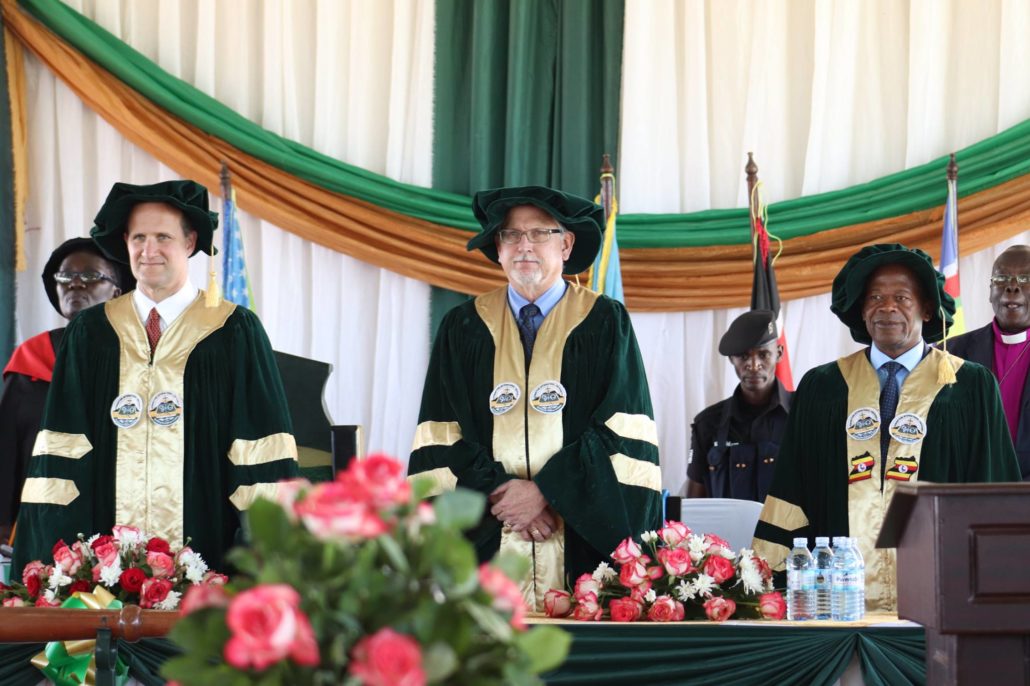
A little while later, we dismissed the prosecutors to their respective groups to see if they could negotiate a deal, and then subsequently sent the judges to the groups to take the plea.  We closed the conference with a lengthy discussion about how this process went (quite well) and to answer whatever questions arose.  As is customary in Uganda, we held an awards ceremony at the end during which each participant received a certificate memorializing the eight hours of training received at the conference.  We also surprised the Principal Judge, Dr. Yorokamu Bamwine, by naming him Pepperdine Global Justice Program’s Person of the Year for his vision and leadership in implementing plea bargaining.  We presented him with a beautifully engraved crystal plaque to commemorate the process.

That night, Mike, Brad, and Darren flew home.  (After Mike returned home, a large Utah newspaper ran a nice story about his involvement in our program).  The following morning, we kicked off the final aspect of our three-week trip.

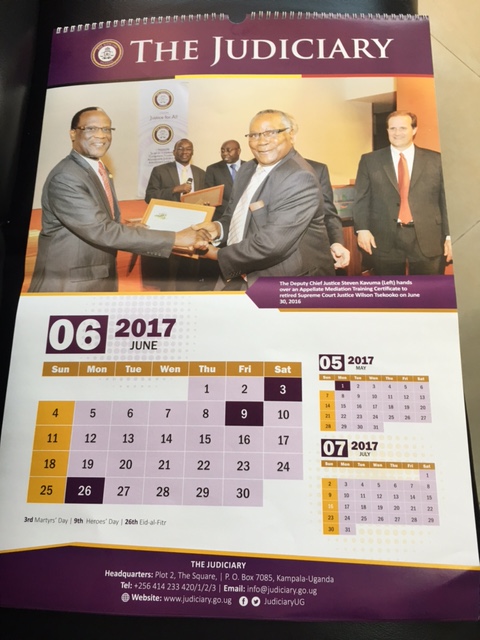
Two years ago, we brought a contingent of Ugandan judges to Pasadena to meet with judges at the United States Court of Appeals for the Ninth Circuit.  During that visit, the Ugandans were introduced to a new concept called appellate mediation.  This process uses mediators to try to assist the party appealing an adverse verdict to reach an out-of-court settlement with the prevailing party in the trial court, rendering moot the pending appeal.  This doesn’t work for all cases (not applicable in the criminal realm), but it is effective at reducing the number of cases that go for a hearing before the court of appeals.  This visit intrigued the Ugandans, and Justice Kiryabwire (very involved in the Pepperdine/Uganda relationship) commissioned two of our interns to write a feasibility study.  The following year, Ninth Circuit Judge Clifford Wallace and Ninth Circuit Mediator Claudia Bernard traveled to Uganda separately and prepared recommendation reports.

This all culminated in a two-day training session hosted by Pepperdine and led by Ninth Circuit Mediator Peter Sherwood.  The vast majority of the Ugandan Supreme Court and Court of Appeals attended the training program, as did numerous court officials and a few private lawyers.  After two days of theorizing and role playing, the room was unanimous – Uganda was going to take a shot at reducing the huge backlog in appellate cases, which has resulted in a five to six year delay between filing the appeal and receiving a ruling.

Certificate Ceremony end of appellate mediation training program

Certificate Ceremony end of appellate mediation training program (Deputy Chief Justice Kavuma, Justice Wangutusi, Peter Sherwood, Justice K)

I had experienced that myself in Henry’s case – we filed the appeal in the summer of 2010 and received a ruling in the summer of 2015.

Even as I write this post, the Ugandan Court of Appeals, under the leadership of Justice K, is in the midst of a pilot appellate mediation program!

One final note – I received word from Henry today that he passed all three portions of his final exams – written, practical, and oral.  Of the 500 who started the program two years ago, only 175 remain.  In September, Henry begins his third year, which will allow him to start interacting with actual patients.

Reaching the Goal

Because the opening ceremony had occurred in Bushenyi prison the day before while most of our team was in Mbarara, and because the prosecutors and many of the defense lawyers from Mbarara traveled the sixty minutes to Bushenyi the next day to keep the momentum moving, our final prison project day hit full stride right out of the blocks.

And it was a good thing.  Bushenyi’s prison population is just under nine hundred, fifty of whom are civil debtors and six hundred of whom are “on remand” – arrested and just waiting for a lawyer and a trial date.  Many have been on remand for five years, just waiting for someone to do something.  (Before plea bargaining got started two years ago, many were waiting seven years on remand – lots of work still to do, but progress is being made).  As we walked in, well over a hundred prisoners crowded in toward us, hoping and praying their names would be called.

When the prosecutors arrived at around 8:45, we quickly distributed among the seven teams the thirty-five files they had brought with them.  By 9:15, we had a Ugandan lawyer for each team and things were rolling.  Over the course of the day, a driver repeatedly returned to the prosecution’s office to retrieve more files, as we devoured each new batch.

All of our American lawyers were fantastic and led their teams ably.  I would be remiss if I didn’t mention two in particular, however.  Utah trial Judge Mike DiReda (my law school classmate) and Los Angeles Public Defender Brad Siegel brought with them a wealth of plea bargaining experience, and, over the course of these ten days, substantially improved the country’s understanding of the practical aspects of criminal case preparation and plea bargaining.  Not only did they provide hands-on training for the thirty-five prosecutors, defense lawyers, and judges with whom we interacted during the prison project, but (as will be discussed in a subsequent post), they helped lead the Second Annual National Plea Bargaining Conference attended by more than one hundred top judicial and legislative officials.

At one point during last Friday’s work in Bushenyi, an inmate assigned to one of the teams told them he wanted to plead guilty even though he wasn’t guilty and even though the court file contained no substantive evidence against him.  He had been on remand for four years and had no confidence that his case would ever be called for trial.  I had remembered hearing the prosecutor the day before mention that a group of cases were going to court on July 15th.  A few follow-up questions later, we learned that this prisoner was on the list.  When he was informed of his impending trial date, he was overcome with emotion, and gratefully withdrew from the program.

Nine hours after we arrived, our team had reached agreements in fifty-six of the sixty-four files we had been given.  In fact, Mike DiReda’s team reached an agreement for an inmate who hadn’t even signed up for plea bargaining.  This happened when one of two co-defendants reached an agreement and informed the team that his co-defendant was also in the prison.  Mike asked if he could speak to the co-defendant, and twenty minutes later, the co-defendant had also happily reached an agreement on his case.

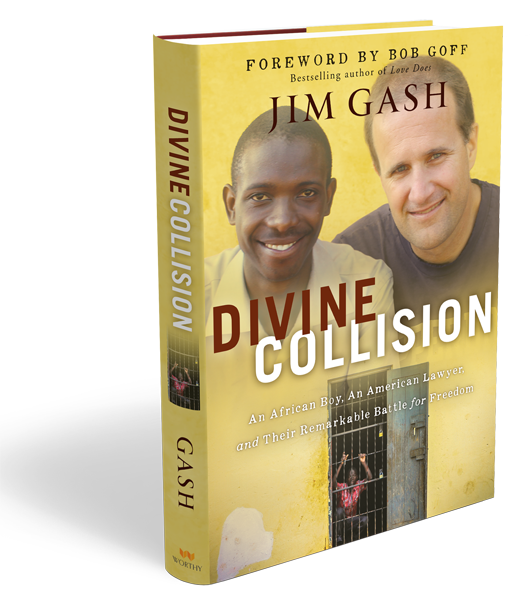
Those of you who have read my recent book, Divine Collision: An African Boy, an American Lawyer, and their Remarkable Battle for Freedom, might remember that Henry is in medical school in Bushenyi – the western Uganda town containing the final prison on our summer program.  Providentially, the prison project week coincided with Henry’s second of three final exam weeks as he completes his second year of medical school.  After his last exam of the week concluded at around 3:00 p.m. on Friday, he made his way to the Bushenyi prison.  Having a large group of Uganda Christian University students on our team made it somewhat easy for me to get Henry into to the prison by simply declaring that he is a student who is on our team.  False?  No.  Misleading?  Of course.  Sue me.

Joline hugged him like a son she hadn’t seen in four months, and our students – most of whom got to know Henry during his six-week trip to the United States earlier this year – mobbed him like he was a pop star.  We had initially hoped to insert him into one of the groups to serve as an interpreter, but he wasn’t fully confident in his ability to accurately translate the local language spoken by most prisoners – he is still mastering this, his eighth language.  For me, I can speak English reasonably well and can order with moderate precision off of a Taco Bell menu.  That’s the extent of my language skills.

As the 4:30 p.m. lock-up time approached, we convinced the warden to extend the deadline by two hours as we were still making excellent progress.  By 5:45, we reached the end of the files the prosecutors had been able to locate, and yet there were still nearly a hundred inmates who still wanted in.  Once again, promises were made (and subsequently kept) to the prisoners that the Ugandan lawyers would return and resume where our teams had left off.

This left only two things to do.  The first . . . was a USA vs. Uganda soccer match.

Earlier in the day, Andrew (my Ugandan counterpart), the prison warden, and I conspired on how we would end the team’s week of tireless work.  I conscripted Joline into the plot, and she went around to each group covertly recording what she guessed were the team members’ jersey sizes.  I sent one of our drivers off to track down four new soccer balls, and purchased a beautifully woven trophy/cup made by one of the inmates.  For his part, the warden sent a couple guards to buy a cow and three goats.

Somehow, word of the impending soccer match leaked to the inmates who ringed the makeshift playing field at 6:00 and waited anxiously for us to join them.  As our team members changed into shorts and donned the Ugandan Cranes jerseys Andrew had acquired for them, the excitement swelled.  When the respective players lined up at mid-field to shake hands, Team USA consisted of attorneys Aaron Echols, Austin Watkins, Darren Gardner, and Mike DiReda, Global Justice Program Manager (and all-around prison project MVP) Jenna DeWalt, and students Greg Lewis, Matthew Chung, and Megan Pepper.

Even though the Ugandans were the home team, they graciously ceded the decidedly downhill slope to the visiting Americans.  They also generously agreed to allow us to wear shoes while they played bare-footed (only a few of them even have shoes).  Just before kickoff, I yelled to the assembled masses that the match would last about fifteen minutes, with the winning team being awarded the prized cup I held high.  The warden translated.  The crowd roared.  The whistle blew.  The game started.

About a minute in, a full volley from a Ugandan midfielder struck Aaron full in the face.  Such a blow would have killed a lesser man, but Aaron brushed it off like a lazy jab from a drowsy fourth-grade girl.  A minute later, Austin tangled with a Ugandan striker and spilled headlong onto the hard red dirt like Michael Phelps entering an Olympic pool.  His knee opened up like a Wal-Mart at 6:00 a.m. on Black Friday.  Not to be deterred, Austin staunched said bleeding with a handful of said dirt and soldiered on.

Clearly sensing both soccer talent and prison project value, the already boisterous crowd punished their vocal cords every time Jenna DeWalt got the ball, which was quite often.

Defenses held strong and neither side seriously threatened to score for the first eight minutes.  Then it happened.

Judge Mike DiReda, who, even at the tender age of “fitty,” knows his way around a soccer pitch, beat the left fullback on the outside and bore down on the keeper from the keeper’s right.  Rather than taking a shot from a sharp angle, Mike crossed the ball to a streaking Darren Gardner (half Mike’s age) who punched the brand new ball between the aging posts into an invisible net.  The goal instantly spiked the decibel level to that of an Ozzy Osbourne concert the moment he bit the head off a rat.  The Ugandans were more excited than we were.

The last few minutes witnessed several shots on our goal, but Greg Lewis defended our net as if he were the secret love child of Hope Solo and Jim Craig.  When the final three whistles trilled, the thrilled crowd rushed the field to congratulate the gladiators on both teams.  Before I awarded the cup to Team USA, I allowed the keepers to swap jerseys.

Keeper Shirt Swap

Keeper Shirt Swap


Shirt Swap 2

Greg will forever treasure the fraying, formerly white tank top he received.  (Greg gave the Ugandan keeper a Pepperdine law shirt, which will serve as an enduring reminder to the inmates from whence we came).

After the crowd noise died down a bit, I previewed the final event of the day while the warden translated.

“We are grateful to you for allowing us to come and visit you here at the Bushenyi Prison.  We thank you for your sportsmanship in the soccer match.  We pray that your cases will move forward quickly and that you will be reunited with your families soon.  Even though we were awarded the cup, we would like to award you the prize.”

I turned and pointed to the large cow and three goats tied to a tree about thirty yards beyond the field and continued.  “Our team of lawyers and students gathered money together and bought for the men’s prison a cow, and for the women’s prison, three goats.  We will slaughter them now and you will have meat tomorrow.”

Standing ovation.

We had previously been told that the prisoners would be honored if we were the ones to usher our animal gifts into the great beyond.  I briefly considered wielding the panga (machete) myself, but thought better of it when I realized that the butchery would be forever memorialized on the interweb.  Two of our lawyer members stepped into the gap – Darren Gardener and Austin Watkins.  Two of our students had initially also volunteered, but one backed out in deference to his animal-loving girlfriend (good call, “Ricky”), and the other got squeamish once he witnessed Darren kneel next to the pinned down bovine and open up its tonsils to ready inspection, which, in turn, unleashed a crimson firehose that sprayed the shins and shoes of those within a twenty-meter radius.

When Darren finished with Bessie and stood to face the assembled onlookers, one could not be blamed for flashing back to any of the recent slasher films – he was straight out of central casting.  Blood misted his face, stained his shirt, flowed down his arm, and dripped from his panga.

I will spare you the details of how Bayou Austin transformed a bleating goat into a bleeding goat.  Suffice it to say that this wasn’t Austin’s first rodeo.  And since Darren was already stained by his new profession, he dispatched the other two goats with quick precision.  Within moments, a team of prisoners had assembled to begin the process of transforming cute and cuddly into nutritious and tasty, something the prisoners only otherwise get on Christmas.  (Several of our team members were befuddled by the scene of a dozen inmates charged with murder, aggravated robbery, and other serious crimes wielding razor sharp machetes in the presence of other inmates, guards, and guests.  None of us felt even a little bit afraid.  This would NEVER be the case in the United States).

After a quick plea bargaining session with the warden, I secured the offending panga as a souvenir for Darren, as you can see prominently displayed in the team photo below.

Team USA

Prison Project Week, Team 3 (Austin, Missy, DT, and Ugandan students)

Prison Project Week, Team 3 (Austin, Missy, DT, and Ugandan students)

While we were gratified to provide the inmates with a memorable day and a free meal, our prayer is that our efforts will free them from both their physical bondage in prison, and from their spiritual bondage as those whose poor choices landed them in prison seek forgiveness from their victims, from their Creator, and from themselves.

Bushenyi Team Photo (with cup)

Bushenyi Team Photo (with cup)

With week two of our three-week trip in the books, we turned our attention to an enjoyable weekend of appreciating the beauty and majesty of God’s creation in Africa.

Kicking off safari (Matthew, Megan, Henry, DT, Saba)

Kicking off safari (Matthew, Megan, Henry, DT, Saba)

Safari Elephants from our rickety boat

Safari Elephants from our rickety boat

Lion Around . . . (that was bad)

Lion Around . . . (that was bad)

A mom and her adopted son

A mom and her “adopted” son

A report on the final, conference-filled week will be coming soon.

Silent Lucidity

Déjà vu enveloped our team on Wednesday morning during last week’s prison project, as we started the day’s activities in plastic chairs under portable tents once again.  This time, though, we were in Mbarara rather than Fort Portal.  After gathering into our seven teams and beginning the process of interviewing the assembled inmates in a prison designed to hold 350 prisoners, but which housed over 1,200, we paused at around 9:45 a.m. for the opening ceremonies.  One of our students covertly distributed a sign-up sheet where we all placed 1,000 shillings (30 cents) into the betting pool on when the ceremony would end.  I went with 11:15.  I lost.  Badly.

Once again, there were several speeches, including one from me.  This time, however, I remembered to introduce my lovely wife.  After an inmate choir performance, the reading of an inmate grievance letter, and a few other speeches, the Principal Judge took the microphone.  Fifteen minutes later something really bad happened.

Before I tell you what tragedy befell the ceremony, let me tell you what I ate for breakfast that morning.  I started with two eggs, a sausage, and some pineapple.  My mistake was then taking a piece of toast and slathering onto it a thick layer of narcolepsy.  At least that’s what it must have been.

As the Principal Judge delved into his speech, I slipped through Queensryche’s door into silent lucidity, drifting in and out of consciousness with the frequency of a hyperactive metronome; I could have easily been mistaken for a life-size bobble-head doll.

At least I was on the third row and shielded from the view of the 1,200 prisoners and others in front of me.

Oh, wait.

I was actually on the front row, wasn’t I?  Yep, just a few feet from the third-ranking judicial officer in the country.  How could it get any worse?

Two words.  Jimmy legs (aka Periodic Limb Movement Disorder).

In an effort to fight off Mr. Sandman, I pinched my wrist, stabbed my palm with my thumbnail, fiddled with my shoes, and constantly adjusted my posture.  All of this left me about as effective at fighting off sleep as if I had eaten a fistful of Ambien thirty-seven minutes earlier.  At one point, I decided to cross my legs at the knee because my ten knee surgeries (yes, ten) has left them a little, shall we say, sensitive to pressure.  Didn’t help at all.

As I once again skateboarded down a steep ramp into a magic new dimension, Jimmy popped in for a surprise visit.  Like an auditioning Rockette, I nearly pulled a hamstring as I catapulted back into consciousness.  Thinking quickly, I made an exaggerated show of re-crossing my legs rather deliberately in a vain attempt to make it appear that I always kicked my legs when I crossed them.  I fooled exactly no one.

Seated directly behind me, Joline was doing her best to keep me from embarrassing myself (and her) by jack-hammering me in the back and neck, and gave me what can generously be called a smack after my kickboxing display.

Mercifully, the speechifying ended at 12:45.

We spent the rest of the day in our seven groups (American lawyer, Ugandan lawyer, two American law students, two Ugandan law students, and a prisoner).  The success rate mirrored the first day in Fort Portal – the process of explaining this new plea bargaining system to a new set of defense lawyers and prosecutors is laborious and time consuming, yet well worth it.

Team Photo at Mbarara Prison

That evening, a few of us joined the Principal Judge at his nearby ancestral home for an hour of reflection and strategizing on the next steps for plea bargaining.  On the two-hour drive back to the safari lodge, Andrew (Ugandan project manager) received a call.

“Yes, my Lord.  Thank you, my Lord.  That is very good, my Lord,” was all we could hear before Andrew hung up.

“That was Judge Batema, the resident High Court judge in Fort Portal,” Andrew reported.  “He took forty pleas today and entered sentences on them.  The prisoners met the team on Monday, reached plea agreements on Tuesday, and received their sentences on Wednesday.  Nothing like this has ever happened in this country.”

Needless to say, we were quite pleased.  Over the course of the next two days, Justice Batema took pleas from another fifty.

The team left before dawn on Thursday morning and returned to Mbarara for the second day at that prison.  As was the case in Fort Portal, the second day was much more productive as the local lawyers got the hang of things and as the prisoners developed trust in the seemingly foreign process unfolding before them.  Because we were moving to the Bushenyi prison for Friday, Andrew and I separated from the group and accompanied the Principal Judge to that prison for the opening ceremony.  Fortunately, I managed to mostly fight off the sleep demons during this re-run of Wednesday’s events.

There is no such thing as fast food in Uganda, particularly outside of Kampala.  So as we travel around the country on the prison project, we bring with us our own cooking team.  Each morning, they set up their makeshift kitchen outside the prison to cook two kinds of rice, beans, matooke (cardboard flavored banana-type thing that is boiled and mashed), gonja (plantains), chapatti (flat bread), and ground nut sauce (made from grinding and boiling small nuts), chicken, and beef.  At around 1:30 p.m., they set up buffet tables under the tents so we can eat quickly and resume work.  When Andrew and I finally made it back to Mbarara, the team was just finishing lunch.

As the afternoon wore on, the crowd of prisoners waiting to have their cases added to the program swelled.  With the help of a prison guard, we prepared a list exceeding 100 of those we didn’t have time to meet with and left it with the Ugandan lawyers who promised to continue in our absence.  (We have since learned that this was largely done).

As we were working for two days under the shadow of soccer goalposts, it seemed only fitting to leave behind a few soccer balls.  I rarely have brilliant ideas, but lightning struck as the driver returned with the four balls I asked him to buy.  We hadn’t brought a change of clothing and didn’t have time for a full-scale soccer match, but we did have time for a penalty-kick sudden-death shootout – five alternating 10-meter penalty kicks for each side.

Suffice it to say that this idea was well received by the inmates and our team.  One of our students, Greg Lewis, was selected as our goalkeeper, and he blocked their first shot.  The crowd on our side erupted.  I took the first shot for our side.  Big mistake.  Not only has my thigh been throbbing for a week now since my attempt to pull my team into the lead, but the Ugandan keeper added insult to my substantial injury by batting my shot away like a hovering mosquito.

Back and forth we went with the keepers dominating the strikers.  The prisoners’ fourth shot snuck just inside the post, just under our diving (in his suit) keeper.

When the Ugandan keeper deflected the final shot by Austin Watkins, the prisoners erupted and started singing and dancing with the wooden cup we had secured from a local wood craftsman – a fitting end to two days of intense case preparation.  The Ugandan prisoners could use a bit more winning in their lives.

Tomorrow, I will report on Friday’s day at the prison, which included a visit from Henry, who is in medical school just a few miles from the prison.

Ugandan Wife?

Those who have spent any significant time in the developing world well understand the wide range of emotions Westerners experience when engaging deeply and personally with the local culture and citizenry.  Our student interns in Uganda this summer have developed a highly cathartic practice of gathering together over a meal nearly every day to share with each other the “highs” and “lows” of each day.

Last night, as our team of twenty-six reflected back upon the week-long, just-completed whirlwind through three adult high security prisons, we gathered in groups to share our “highs” and “lows” for the week.  Many tears were shed during this much-needed emotional exhale, but not nearly as many as were shed during the week.

When it came my turn to share, I started with my low for the week, which brings me back to last Sunday afternoon as the project metaphorically kicked its legs as it anxiously climbed into the starting blocks and waited for the clap of the starter’s pistol.  (My next blog post will provide a fitting bookend to the week with a description of my “high”).

My biggest concerns going into the prison project centered around (i) the availability of Ugandan lawyers to represent the prisoners, and (ii) the production by the prosecution of what Ugandans call “disclosures” – a copy of the evidence against the accused person from the court and police files.  Both of these critical ingredients for plea bargaining to be successful have been in short supply in prior projects, which is why I have been begging, pleading, and cajoling our Ugandan counterparts to ensure this advance work was done before we arrived.

On last Sunday afternoon, however, my morale was residing just a few meters north of the Mariana Trench.  After lunch, Joline and I accompanied Andrew Khaukha (project manager on the Ugandan side) to the Katojo Prison in Fort Portal for a pre-project scouting trip to ascertain (i) how many prisoners were interested in plea bargaining, and (ii) what type of facilities would be available to us.  We were heartened to learn that more than one hundred had registered to participate, but disheartened to discover that no public address system, chairs, tables, or tents had been secured for our work at the prison – this, even though the Chief Justice (top dog) and Principal Judge (third-ranking judicial officer in the country) would be traveling the four hours from Kampala to Fort Portal to ceremonially launch the week-long program.

That lack of preparation foreshadowed what quickly became my low for the week – we had no files waiting for us and only a couple Ugandan lawyers were confirmed for the next day.  This left me with a piercing sense of foreboding as I imagined having to tell the seven American lawyers who had paid handsomely for the privilege of devoting a week of their lives to trying to help a judicial system that struggled to help itself.

“Don’t worry, Prof, it will be fine.  Let me take care of it,” Andrew said on Sunday afternoon with orders of magnitude more confidence than I could even imagine at that point.

And yet, over the course of about three hours, Andrew had Harry Pottered into existence everything we lacked.  We rented four “hundred-person” tents and one hundred plastic chairs from a local hotel (they didn’t have any spare tables), and “hired” a reasonably effective PA system from a kid who met us at a gas station.

A handful of diplomatic calls to local lawyers produced a half-dozen promises to be at the prison at 8:30 the next morning, and a stern (though respectful) call to the lead prosecutor in the area led to him coming to our hotel that night during dinner.  While most of us ate, our “Secretariat” designed both electronic and paper systems to ensure that the thirty-five sets of disclosures were properly catalogued and evenly distributed to the seven teams that, by this time, consisted of (i) one American lawyer, (ii) two Pepperdine law students (one is actually a Baylor student who has joined our program for the summer), and (iii) two Uganda Christian University law students (we have been including UCU students in our prison projects for several years now).

Not only did the prosecutor deliver to us thirty-five photocopied files, but he also stayed and reviewed his copy of the files, and then wrote out initial plea offers for each of the thirty-five prisoners.  This would enable the teams to convey these offers to the prisoners during the interviews the next day.

For the next few hours, the teams reviewed and discussed the files in preparation for their work.

Austin Watkins  and team

Tennessee lawyer Austin Watkins, Missy, DT, and UCU students

LA Public Defender Brad Siegel, Cat, Jenna, and UCU student

LA Public Defender Brad Siegel, Cat, Jenna, and UCU student

Baylor Professor Brian Serr, Baylor student Megan Pepper, Mark, and UCU students

Baylor Professor Brian Serr, Baylor student Megan Pepper, Mark, and UCU students

Utah Judge Mike DiReda, Emily, Morgan, and UCU students

Utah Judge Mike DiReda, Emily, Morgan, and UCU students

We arrived at the prison just before 8:00 a.m. on Monday in an effort to get things started before the CJ and PJ arrived, along with their retinues and the press corps.  Our Nootbaar Fellow, Nicole Banister, is in Uganda for a year as a mediator in the Family Division of the High Court and is with us this week.  She and I (along with one of our students) were the only of our American team of twenty-six who had ever been in a prison in the developing world.  (Three years earlier, Nicole had been a student intern in Uganda during our first-ever prison project in an adult prison, which had actually taken place in this very prison).  Our team members’ wide eyes started to water a bit as the reality of the prison conditions bum rushed them.  As we walked in, the warden informed us that there were over 1,200 prisoners, even though the capacity was 318.

We were escorted into a concrete courtyard where all 1,200 prisoners were mingling with even wider eyes as the “mzungus” set up shop under the just-erected tents.  After we assembled into seven groups at around 8:30 (the agreed-upon starting time), we looked around in vain for the lawyers.  Though the ceremony was scheduled to commence at 9:00, no one besides us could be found.

This was completely expected, though, as a Ugandan event starting on time is a winged unicorn.  Not wanting to lose any time, we conscripted a guard to locate and sequester those prisoners for whom we had files so we could begin interviewing them.  By 8:45, we were rolling.

At around 9:30, local governmental figures began arriving, along with a few local lawyers, three of whom had participated in the project three years ago.  Fortunately, I recognized them, and they recognized me.  As they arrived, I briefed them on what we were doing and placed them into a group.

Finally, at around 10:00, the guests of honor, the press corps, and PA system arrived.  Fifteen minutes later, the speeches began.  Two hours later, they mercifully ended.  Among those speaking were CJ, PJ, me, the local mayor, the local High Court Judge, and a few others.  During his speech, CJ introduced his wife to thunderous applause from all present.

Soon thereafter, I spoke.  And yes, you guessed it – I completely forgot to even acknowledge my better half, much less ask her to stand to be recognized.  After I spoke, the emcee joked (in the local language) that I had been to Uganda so many times that I needed to get myself a Ugandan wife.  Everyone laughed heartily at this except, of course, Joline and me.

A few minutes later, the emcee called me and the CJ up to close the ceremony, telling me that CJ had some gifts he wanted to present to me.  These gifts were copies of the Ugandan constitution, the plea bargaining rules, and the sentencing guidelines – the tools we are using in this project.  After receiving these gifts, I seized the opportunity to seize the microphone to thank CJ and to take a shot at redemption.  “Thank you, My Lord,” I said because that’s how judges are addressed here, “we will use these tools as we assist the Ugandan advocates in delivering justice to these assembled prisoners.  For a moment, I feared you were going to present me with a Ugandan wife!  But my wife, Joline, is actually here with me, and I would like her to stand for recognition.”  I got the laugh and applause I sought from the crowd, and I think Joline will let me come home next week.

Phew.  Better late than never, right?

Eventually, six Ugandans advocates showed up, completing all but one of our groups.  In the afternoon, about five prosecutors arrived at the prison.  This allowed any group for which the prisoner accepted the plea offer – or who wanted to present a counteroffer – to move toward complete resolution right then and there.  In fact, about a dozen plea agreement forms were filled out, signed by the prisoner, signed by the Ugandan lawyer, and signed by the prosecutor.  All that remained was the taking of the plea in court, and sentencing by the judge in accordance with the plea agreement.  In Uganda, however, that last piece can take a really long time.

That night, several prosecutors, most of the Ugandan defense lawyers, and the local High Court judge joined us for dinner.  The prosecutors brought with them about fifty new files.  They hadn’t yet made photocopies, but they agreed to allow our teams to look directly at the original files – something that rarely happens – in order to allow the team members to prepare for the next day’s interviews.  This case preparation continued late into the night.

The next day, a crowd of prisoners who had been skeptical of plea bargaining assembled and asked to be added to the program.  There were over a hundred of them.

Case preparation continued in earnest until about 2:30, when we had to wrap things up and get on the road to our next destination.  At one point, I looked around and saw about seven hundred prisoners watching us from within a thirty-yard radius.  Not a single guard was around, yet we didn’t feel even a modicum of fear to be unprotected so close to so many accused of murder, rape, aggravated robbery, kidnapping, etc.

When the dust settled, the teams had completed settlement agreements on close to seventy cases.  While the American members of our teams were quite pleased with these individual outcomes, I was elated that the Ugandans (prisoners, prison officials, prosecutors, and defense lawyers) all seemed to understand the process and pledged to continue without us after we left.

Just after nightfall, we arrived at a safari lodge on the lip of Queen Elizabeth National Park, which is where we would be spending the next five nights.  Unfortunately, however, we weren’t able to enjoy the stunning view of the Park for several more days, as we routinely left before sunrise and returned after sunset.

More in a day or two.

Hold on Tight

Tricked out motorcycles and flowing beards littered the music video of one of my favorite songs when I was just waking up to rock and roll.  Unfortunately, adherence to ZZ Top’s lingering directive to “Hold on Loosely” transformed my iPhone into a “bye-Phone” last Thursday night on the way home from a pizza dinner with our student interns here in Uganda.

Allow me to explain (and stay with me here).

I can’t fully articulate the philosophical underpinnings of the solution to Bart Simpson’s timeless Zen-infused riddle of, “How is it possible for something to suck and blow at the same time?”  I can, however, provide an irrefutable example — Kampala traffic.

As my colleague Jenna and I were steeping in the suck/blow phenomenon in a circa-1980 Toyota Corolla, I lowered my window to half-mast to compensate for the taxi’s comatose air conditioner.  We were dead still, and had been for about ten minutes, so I pulled out my iPhone 6 Plus and started thumbing away at my e-mail backlog.  Because the phone is so big, and because I generally type with the phone in the vertical position, I hold it near the bottom as I type.  And because I am a huge ZZ Top fan, I hold on loosely to the phone while typing.

As I did so, I acquired a new friend who spontaneously materialized from the darkness and reached through the window to generously relieve me of the burden of responding to my pile of e-mails.  He then darted through and around the coil of traffic and vanished almost as quickly as he had appeared.  I was so momentarily befuddled by my unhanding, I fumbled with the door lock and latch long enough to permit myself only a fleeting glance at the back of his head.

This most unpleasant turn of events presented me with the singular pleasure of discovering how to locate and erase my “lost” iPhone.  Hint: substantial delays inject themselves into the process when one forgets the answer to the two supposedly simple security questions necessary to log into iTunes from another continent.  Apparently, I don’t remember EITHER my best friend in high school OR my first car, though apparently these answers were supplied by me when I was in more lucid state.  This bout with early-onset Alzheimer’s earned me the opportunity to enjoy Apple’s “hold music” for the better part of an hour.  Surprisingly, the Easy Listening selection failed to temper my rising frustration.  Ultimately, the Genius who brought an unceremonious halt to my impromptu sing-along session with Simon and Garfunkel was able to assist me with (i) locating a signal from my erstwhile prodigal phone, and (ii) triggering the “erase” feature on said phone.  I briefly contemplated hiring another taxi so I could locate and assist my new friend as he answered my e-mails (at least that’s what I assume he was doing), but as I zoomed in with the GPS locator, I realized that it could only mark out a 100-yard radius in a neighborhood with, shall we say, lots of room for improvement in the safety category.  And no, I didn’t call the police.  If you have ever been to Uganda, you know precisely how effective that would have been . . .

The next evening, after the closing ceremony of a spectacular week-long mediation training program delivered by Mitch and Selina, I had the opportunity to demonstrate just how mentally gifted I really am.  The forum for my display of intellectual prowess was on the way to the airport to pick up my wife and about ten others flying in from all over the United States and from Rwanda.  Because so many Uganda rookies were coming in at the same time, I decided to accompany the driver in the court’s thirty-passenger mini-bus to go and fetch them.  I also invited along one of our students interning in Uganda who is a bit sweet on one of our other student interns currently based in neighboring Rwanda working for the Chief Justice of that country.  Let’s pretend her name is “Shelby.”

Shelby and I decided not to tell her boyfriend “Ricky” that she was coming to the airport with me so it would be a surprise.  In fact, we affirmatively lied to him.  (Lying is OK if it is done in the name of love, right?).  Luckily for Shelby and me, we got to experience the suck/blow traffic again.  This time, however, I didn’t roll the window down, but opted instead to slide the windows open as buses are designed to do.  As Shelby and I were talking and looking at her computer, a shady looking dude approached the motionless bus from my side and peered into the window from his tippy toes.  As I slid the window shut, the dude’s buddy lurch-reached into the bus on Shelby’s side and swiped her purse.  Like his compadre from the night before, he disappeared into the darkness as I yelled out the window, “Stop the thief, he stole a purse!”  The onlookers stared at me quizzically, likely confused by the claim that my purse was stolen.

Guess what was in Shelby’s purse, besides credit cards, a debit card, cash, and her driver’s license?  Yep, her iPhone.  She quickly activated the tracking software and erased her phone.  The moral of this story?  Jim is a pee-brained idiot.  (And yes, I know I spelled pea-brained wrong, but I was being ironic).

I added an exclamation point to this truism just moments later when Ricky e-mailed me as he boarded his one-hour flight from Rwanda to Uganda to let me know all was well.  My inner Einstein typed back (on my internet-connected computer BECAUSE MY iPHONE HAD BEEN STOLEN) that Shelby and I would see him soon.

“Wait, you just told him I was coming with you to the airport?” she sadly asked.

See?  I am an idiot.

I am also unspeakably cruel.

In an effort to make up for my spoiling the surprise, I had Shelby hide while I greeted Ricky and the other intern from Rwanda after they landed.  Ricky gave me a hug, even as his eyes skipped and darted around and among the other airport greeters.

“Did you get my e-mail about Shelby coming?” I asked.

“Yes, just now,” he said with a blossoming smile.  “Where is she?”

“Sorry, Ricky, I was just kidding,” I said with an even bigger smile.  “She’s back at the hotel waiting for you.  That was mean, wasn’t it?”

“Are you serious?  She’s not really here?” He looked like a kid whose puppy had just been snatched up by an owl.

“Actually, she is here, but she is hiding,” I said, as I pointed to where she had been earlier.  Only she wasn’t there, she had moved a bit and was still not visible.

“Where?” he asked frantically.

When I didn’t see her, I plumbed the depths of depravity even deeper by saying, “Just kidding, she’s not really here.  Got you!”

I thought he was going to hit me, but Shelby thankfully jumped out and hugged him, thus saving me what would have been a well-earned bloody nose.

A few minutes later, Joline arrived with lawyers Aaron Echols (Dallas-based Pepperdine Law grad whose wedding I was honored to perform), Austin Watkins (Nashville-based Pepperdine Law grad who lived in my house when I lived in Uganda in 2012), Mike DiReda (Utah judge with whom I graduated from Pepperdine in 1993), Brad Siegel (Los Angeles Public Defender who has helped host several delegations of Ugandan and Guatemalan judicial officials on SoCal study tours), Darren Gardner (DC-based Kirkland & Ellis associate I met during the Divine Collision and REMAND tour earlier this year when we showed REMAND at Kirkland’s DC office), Brian Serr (Baylor Criminal Law Professor I also met on the Divine Collision tour), Jon Wood (Ohio-based corporate lawyer who roomed with one of my Pepperdine colleagues while in law school), and Avery Wood (Jon’s daughter who just finished her freshman year at U of Alabama).

Shockingly, nothing was stolen on our ride back to town.

Saturday was a day of shopping and sightseeing by the group.  Joline and I ducked out twice – first to catch up with good friends from Baylor with whom we are exploring and implementing joint global justice projects (more on that in later posts), and second to spend some time with my God son and his family – the Kiryabwires, with whom Joline and I have become quite close over the past six years.

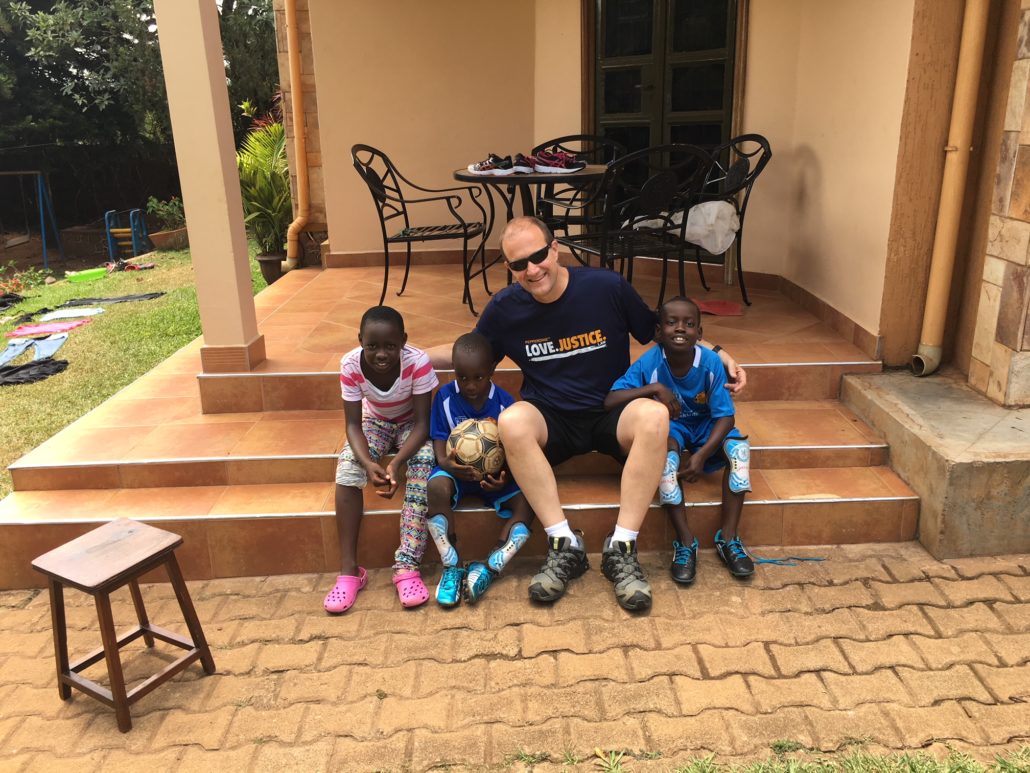
The K Kids

The K Kids

On Sunday morning, thirty-three of us (including four drivers and two armed body guards) piled into a mini-bus, a van, a truck, and an SUV.  The destination was Fort Portal where our one-week prison project would launch the following morning.  For lunch, we stopped at what should be considered one of the eight wonders of the world – a sprawling resort constructed from logs on a ridge overlooking a breathtaking crater lake and valley.  Lunch was great, but the views from Kyaninga Lodge are other-worldly.

Jim and Joline at Kyaninga Lodge

Jim and Joline at Kyaninga Lodge

Prison Project Team

Prison Project Team

That evening, we were joined by 13 Uganda Christian University law students and then broke our group into seven teams to review thirty-one sets of photocopied police and court files we had just received.

The next post will begin with our entry into the Katojo high security adult prison, which was built for 318, but currently houses 1247.  Just over 1,000 of them have no lawyer, no court date, and dwindling hope as the months and years have dripped away.

The African prison rookies sported wide eyes and a tight hold on their computers.  As they soon learned, however, the roller coaster they were boarding required them to hold on more tightly to their emotions and to their conception of reality.

More soon.

Enigmatic Riddle Solved (I Think)

After spending Sunday ensuring that all of the logistical arrangements were in place for the kickoff of the week-long mediation training, we were ready for the opening on Monday morning.  This training program is the product of a Memorandum of Understanding (an agreement similar to a contract) between Pepperdine’s Law School and Uganda’s Justice, Law, and Order Sector – the umbrella organization consisting of eighteen legal institutions, including the Judiciary (and prisons, prosecution, police, department of justice, etc.).  The law school’s Global Justice Program manages the MOU, and I am privileged to direct the GJP and to serve as the MOU’s project manager on the Pepperdine side.

The GJP, in turn, engages other partners to provide training for our Ugandan friends.  One such important partner is Pepperdine Law’s top-ranked Straus Institute for Dispute Resolution.  One of the many areas in which Straus has expertise is mediation training; the main mediation training program is called Mediating the Litigated Case.  This industry-leading week-long course is taught all over the world, including in Uganda in early 2014.

While Ugandans — indeed most Africans — have been privately mediating disputes for centuries, the implementation of public justice systems by Western colonial powers in the 1900s injected the adversarial system into their culture.  This, combined with insufficient judicial resources, resulted in crippling delays in the adjudication process, which caused huge case docket backlogs.  Over the past decade or so, there has been an effort to infuse mediation back into the public consciousness in order to reduce the delays, and there is now a huge push to institutionalize alternative dispute resolution (mediation in the civil realm, and plea bargaining in the criminal realm) in the public justice system.  Pepperdine has had the privilege of assisting and encouraging Uganda in this regard on both the civil and criminal side.  Hence, the focus of this three-week trip – one week of mediation training, one week of plea bargaining work, and one week consisting of a plea bargaining conference and an appellate mediation conference.

Those who have spent any amount of time in Uganda know that formality and protocol are very important here.  Accordingly, speeches proliferated in the opening of the mediation training program.  As the project manager on the MOU, I was called upon – along with the Principal Judge, the head of the Judicial Studies Institute, and the High Court Judge leading the mediation rollout – to say a few words of welcome, background, and explanation of how the training program came to be.

Opening Ceremony

Opening Ceremony

I also had the privilege of introducing the two expert trainers – Selina Shultz (lead) and Mitch Goldberg.  (I don’t know my butt from a hot rock on mediation training, but fortunately I know those who do).

Selina Shultz

Selina Shultz

Judge Mitch Goldberg

Judge Mitch Goldberg

Tuesday morning, I woke up to a riddle, wrapped in a mystery, inside an enigma – all of which resided on my bathroom floor.

Let me explain.

When I am in Uganda, I take an ambien sleeping pill each night to ensure that (i) I adjust to the time difference, and (ii) I get a full night of sleep each night so I can pedal hard throughout the next day.  That pill often alters/erases one’s memory during the time it is in effect.  Well, on Monday night, I took an ambien, climbed into bed, and watched CNN as the Orlando tragedy continued to unfold.

The next morning, I woke up to something that initially stumped my inner Columbo.  Now, it is not all uncommon to find cockroaches in Ugandan hotels.  It is quite unusual, however, to find dead cockroaches in the middle of the floor.  Thus, my utter perplexity when my flick of the bathroom light switch revealed this:

Morning Surprise

Morning Surprise

Not only was the cockroach dead, but it was squashed.  I stared quizzically at it for a full minute before I had an epiphany.  Circumstantial evidence pointed to only one conclusion – I must have smashed the poor b@$+ard in the dark during the night when my Coke Zero from dinner coaxed my bladder into demanding the rest of my body engage in a groggy pilgrimage to porcelain alter.  What are the odds?

Anyway . . .

It has been so fun catching up with our eleven student interns here for the summer, including at a milkshake-laden dinner at a South African steak joint in the Golf Course Hotel on Tuesday night.

Dinner with the Summer Interns

Dinner with the Summer Interns

Wednesday and Thursday have run quite smoothly and have been filled with planning meetings for the upcoming prison project.

Between meetings, I have had the privilege of watching the expert mediation trainers at work – they are truly outstanding and the nearly fifty judicial officers are drinking deeply from the wellspring of knowledge overflowing before them.

The prison project lawyers arrive late Friday evening.  Accompanying them will be my bride of exactly 26 years.  Happy Anniversary, Joline!  This will be the first time since we were married that we weren’t together on our special day, but I am grateful she is flying in tomorrow.

Nineteen

I can’t help but recognize the metaphor in the rising sun peeking over the seven hills of Kampala this Sunday morning.  I have no memory of ever taking the time on any of my prior visits to Uganda to sit still and appreciate the beauty and simplicity and constancy of the equatorial sunrise – 6:45 a.m. every single day.  I need to do better.  I need to daily draw a connection between the faithfulness of this sun rise and the infinitely more sustaining son rise that gives all of this meaning.

I find myself feeling less anxious about the soon-to-unfold events of this trip than perhaps any other of the prior eighteen.  I’m not exactly sure why, but I suspect it is because this one is starting out less frenetic than the others.  And that’s not an accident.  I am often a slow learner, but I eventually tend to figure things out.  My modus operandi has heretofore been flying in the night before the launch of a series of fast-paced programs.  This has too often led difficult sleep adjustments (ten-hour time difference), not to mention awkward wardrobe malfunctions due to the dilly-dallying of my suitcases on one or more of the layovers.

As the details of this three-week trip began to crystalize, my hyper-organized Global Justice Program colleague, Jenna DeWalt, gently suggested that we build into the schedule some leeway to allow those traveling with us (most for the first time) to get their feet under them before we ask them to run.  Good advice well taken.

So we set off on Thursday afternoon – Jenna, Judge Mitchel Goldberg, and I from Los Angeles, and Selina Shultz from Pittsburgh.  We hooked up with Selina in Amsterdam, ultimately landing in Entebbe a little before midnight, and settled in at our Kampala Hotel at around 1:00 a.m.  Fortunately, there was nothing eventful about the flights, other than the fact that all of our suitcases made the journey with us – I am now 13 wins and 6 losses in this department, but who’s keeping score.  (I guess I am).

This three-week trip is conveniently divided into three substantially equal parts.  The first week is mediation training, the second is the prison project, and the third is conferences.  Those who know me even moderately well know than I am incapable of training anyone in mediation.  I know my limitations, but I also have friends, who themselves have friends.  Which leads me back to the all-star mediation trainers, Mitch and Selina.  Which, in turn leads me back to John Napier.

In 2009, Pepperdine launched its Nootbaar Fellows program, pursuant to which a Pepperdine Law alum serves the Uganda Judiciary for entire year.  John was our first, and became the first-ever court-annexed mediator in the country.  Since then, the fellowship program has helped launch a movement to expand mediation to the entire country in an effort to reduce court congestion and case backlog.  Since Pepperdine’s Straus Institute for Dispute Resolution is the world-leader in dispute resolution training, it only made sense to invite Straus to partner with our Global Justice Program.  This partnership led to the first-ever national mediation training workshop in 2014, and its follow-on workshop that begins tomorrow.

Mitch was one of the trainers in 2014 and has been itching to return for round two.  Having received an advanced legal degree in dispute resolution from Pepperdine, Selina has become one of the mediation trainers for Straus and jumped at the opportunity to join this trip.  So Monday morning will kick off a week-long training workshop for fifty Ugandan judges who will soon become the core of Uganda’s mediation corps.

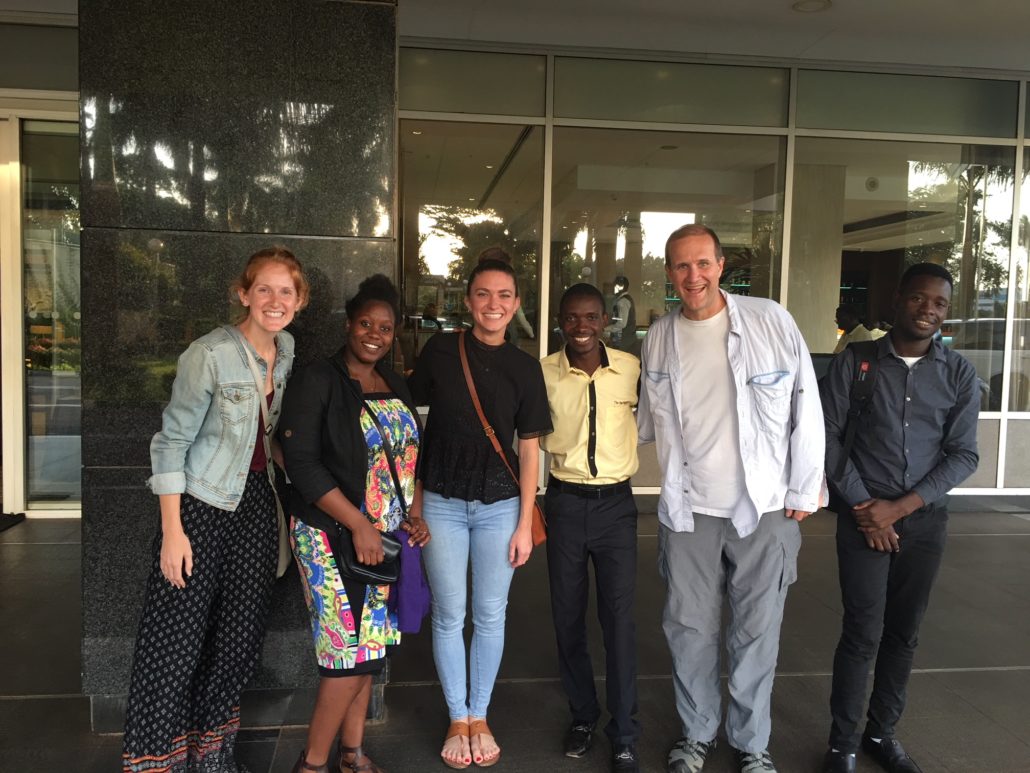
But all work and no play makes Jimmy a dull boy, so we spent Saturday in one of my favorite places in Uganda – Jinja.  Before heading out of Kampala for the two-hour drive, we stopped to say hello to our Pepperdine summer interns who are serving eight-week internships with Ugandan judges.  One of them, Emily, jumped in the car with us (along with Nicole, our current Nootbaar Fellow, who is serving as a year-long mediator in the Family Court); four of them had gone ahead to Jinja for a day of white water rafting and bungee jumping.

Our first stop was the Source Café, which was started by a team of missionaries nearly twenty years ago.

First Stop in Jinja

First Stop in Jinja

From there, we dropped Mitch, Selina, Emily, and Nicole off in a fishing village on the banks of the Nile River for a two-hour tour of the Nile and Lake Victoria, which is the source of the Nile.  While they were touring, Jenna and I went to visit an American friend and her husband of about two years.  It was a joy to catch up with her, a few of her many adopted Ugandan girls, and to meet their adorable new son.

Before returning to Kampala, our group met up with four of our student interns and watched them climb a rickety platform, strap their feet to a rubber band, and then hurl themselves a couple hundred feet toward the Nile.  There is nothing like bungee jumping in the developing world if one wants to tempt fate.

What could possibly go wrong?

What could possibly go wrong?

Having done this twice in 2012 (once each with my two youngest kids), I passed on the opportunity to become a recidivist.

Strapped to Joshua on my first plunge in 2012

Strapped to Joshua on my first plunge in 2012

Today is final preparation day for the mediation training.  While Selina and Mitch are training their hearts out the rest of the week, Jenna and I will be preparing for the arrival of a team of American lawyers on Friday who will work alongside our student interns, Ugandan lawyers, and Ugandan law students on our annual prison project.  This year, we will work in three prisons (Fort Portal, Mbarara, and Bushenyi), the first of which was the site of our first-ever pilot plea bargaining program in adult prisons in 2013.

Day One of 2013 Prison Project in Fort Portal's Katojo Prison

Day One of 2013 Prison Project in Fort Portal’s Katojo Prison

Stay tuned for regular updates over the next three weeks.

For those wondering about the title of this post, it derives from 1980s novelty song that raced to #1 on music charts around the world.  I will let you decide whether this was or was not a clever way of indicating that this my nineteenth trip to Uganda.

Summer Trip to Uganda, Anyone?

It feels like I just returned from Uganda, but I am now deep in the planning stages of the next trip — #19.  It will start out with a week of mediation training led by Pepperdine’s world-renowned Straus Institute for Dispute Resolution, and then transition into our annual five-day prison project, after which two training conferences will be held on plea bargaining and appellate mediation.  Three weeks in all.

And yes, we still have several open spots for lawyers looking to give voice to the voiceless and have a life-changing adventure deep in the heart of Africa.  If you can extricate yourself from your law practice for about ten days beginning on June 16th and are able to self-fund your trip, shoot me an e-mail in the next week or so at jim.gash@pepperdine.edu.  Prior experience in the criminal realm is preferred, but not required.

Last month’s trip was a whirlwind, during which I had the chance to:

Meet up with one of my former students who was in Uganda working on her dissertation;

Re-connect with a good friend from Wales who is dedicating his adult life to trying to keep Ugandan families intact;

Secure housing for our 12 students spending the summer in Uganda and finalize their court assignments;

Witness the integration of new video system on which we have been advising our Ugandan friends, which will allow kids to testify remotely against their assailants;

Renew deep friendships with dear friends in the judiciary, including the Director of Public Prosecutions, the Secretary of the Judiciary, the Chief Registrar, and numerous High Court Judges;

Celebrate the birthday of my God son and dine with his family – the Kiryabwires;

Mark turns two

Mark turns two

Re-visit one of the worst places on earth – the National Rehabilitation Center – where juveniles are sent after being convicted of crimes, and plot with several Ugandans and Americans (Sixty Feet) about how to make much-needed changes;

Collaborate with new and old friends in the Kampala office of the International Justice Mission and plan numerous projects together in the near future;

With Shawn Kohl at IJM's Kampala Field Office

With Shawn Kohl at IJM’s Kampala Field Office

Return to the maximum security prison (Luzira) where REMAND was filmed to envision a program whereby faith-based identity transformation is introduced to assist with rehabilitation;

Journey six hours each way to have lunch with the Chief Justice at his village home on a hill overlooking the majestic Queen Elizabeth National Park;

At CJ's home near Queen Elizabeth Park

At CJ’s home near Queen Elizabeth Park

Providentially, the trip to see the Chief Justice took us right by Henry’s medical school, so we had a chance to stop and see him between classes.

Andrew and I with Henry at KIU

Andrew and I with Henry at KIU

Henry continues to excel and is closing in on the end of his second year of study.  For those who read prior posts, his lost immunology exam was eventually found and, when graded, showed that Henry passed the test with flying colors.  This left Henry among a small group of students who passed every exam on the first try.

Henry’s family remains embroiled in a testy dispute over the land on which he grew up, though things seem to be moving in favor of his mother as she tries to prevent Henry’s aunt from trying to illegally seize the property in the wake of Henry’s father’s death.

On the very exciting front, Henry’s younger brother Joseph was just admitted to law school!  After being released from twenty months on remand in a juvenile detention facility with Henry, Joseph decided he wanted to be a lawyer in order to help prevent what happened to him from happening to other kids.  Joseph will enroll in Kampala International University in August.

While I was on the book and film tour with Henry, several people approached me asking how they could be helpful to Henry’s family.  One important way is to contribute to Joseph’s legal education.  (Henry’s medical school tuition is being covered by my parents and Colin and Amy Bachelor).  I am more than happy to answer whatever questions anyone has about Joseph’s tuition and living expenses, or the cost of Henry’s living expenses while in school.

On the REMAND front, we had the final preview screening at the historic Egyptian Theater in Hollywood a few weeks ago.  We were thrilled with the attendance and the film was well received.  In fact, we were offered an automatic entry into a film festival by one of the attendees.  A new website is currently under construction and a wide-scale effort to enter numerous film festivals will begin later this month.

Divine Collision continues to be well reviewed and continues to open doors for me to share this story of transformation on two continents.  I had a chance to speak to about a thousand Pepperdine students at their final convocation (chapel) gathering a couple weeks ago, and will be speaking at a break-out session at Pepperdine’s annual Bible Lectures this coming Thursday (3:30-4:15 in the Raitt Recital Hall).  Guideposts magazine ran several stories about Henry and our family in the May print edition and on the web.

18 And Life To Go

One of my favorite songs when I was in college was “18 and Life to Go” by Skid Row.  That pop-metal song crashed back into my life as I traveled to Uganda this weekend for the 18th time.  My commitment to my beloved second country ensures that while this is trip 18, I do have “life to go” in my travels here.  But before discussing this upcoming week’s activities, here is a quick recap.

The Divine Collision book tour Henry and I started in late January ended in early March after a whirlwind spin through Texas involving three chapel talks at Baylor, a national radio interview, and three screenings of REMAND in Waco, Dallas, and Houston.  It was so good to catch up with dear friends along the way.

Breakfast in Dallas with Echols and Delaneys

Breakfast in Dallas with Echols and Delaneys

Prior to Henry’s departure, the BBC broadcast the radio interview Henry and I did with them and published an extensive feature on our story.  The Washington Post also published a nice article.  Following the BBC story, I received calls and e-mails from Nigeria, Ghana, the UK, and Uganda, some of which have raised intriguing new possible projects.

On March 3rd, Henry traveled back home to resume his medical school studies.  We loaded him up (down?) with lots of first-world “essentials” (developing world “luxuries”) for his family – frying pan, Tupperware, chocolates, etc.

We stopped at the beach in Malibu on the way to the airport for one last photo and said our emotional goodbyes as Henry boarded the plane for his 21st flight during the trip.  Memories to last a lifetime.

Farewell to Malibu

Farewell to Malibu


Heading Home to Uganda

I also sent Henry home with the near-final cut of REMAND – the documentary about how his case led to substantial reform in Uganda’s criminal justice system.  (Incidentally, the final cut will be shown on April 12th at the Historic Egyptian Theater for the first and only time prior to going on the film festival circuit – tickets available here.  Please pass along this invite to others).  Henry showed the documentary in his local village to a crowd assembled the night before he returned to medical school.

Prior to returning to Uganda, Henry had learned that he was among a list of approximately 200 of the then-remaining 360 students in his medical school class (which had started with 500 eighteen months ago) who had to re-take one or more of his examinations from the prior semester in order to advance to the second semester of his second year.  Henry was quite surprised that he had to retake Immunology, which he had believed was one of strongest subjects.

Upon returning to school, though, he discovered that he had not performed poorly on the exam, but instead that his was one of eighty students’ exams that had been lost by the professor.  All eighty had to take it again.  Soon thereafter, Henry was notified that he passed the retake and advanced to his fourth semester.

When all the dust settled on the third semester, only 280 of the original 500 students remained.  The “sifting” process will continue for a few more semesters, with the expectation being that around 200 will graduate at the end of six years.  Henry is quite confident he will be among them.

During this 18th trip, I will be nailing down the details of the upcoming summer prison project (June 17-27), finalizing a couple national conferences we will be hosting in late June/early July, arranging everything for this summer’s student intern class, and exploring new projects and expanding existing ones.

Before I left Malibu, I had my second call with a government official in Nigeria about potentially working with them on judicial reforms, and hosted a delegation of Guatemalan lawyers who are exploring possible criminal justice reform along the lines of those undertaken by Uganda.

Divine Collision continues to be received and reviewed well – thanks to those of you who have shared your thoughts on Amazon.  If you have had a chance to read the book, please let your voice be heard.  My publisher tells me that getting to 100 reviews on Amazon is an important benchmark.  As of today, we are nearly halfway there:)

Through New Eyes

During the four weeks Henry has been in the United States, I have learned to see daily life through new eyes.  It is so easy to take for granted many aspects of life in the developed world.  Henry was amazed by how good the roads were once he landed on January 26th – “they are all tarmac and almost no potholes.”  Equally confounding to him was the fact that drivers operated their cars in an “orderly fashion,” obeying traffic signals and staying in their lanes.  Having driven in Uganda during the six months I lived there in 2012, I knew what he meant about how different driving in both locations could be.

“Magic” is what he declared my garage door opener, and “Is the power always on?” is the question that soon followed.  Henry’s family first acquired electricity (one socket) in 2014, and continual flow of electricity is unusual.  One of the surprises he had was that there weren’t flying cars crowding the sky, as is supposed by many Ugandans living in the rural areas.

After Henry was released from prison in May of 2010, he enrolled in Bob Goff’s Restore Leadership Academy in Gulu, Uganda.  During his two years there, he got to know Bob fairly well due to Bob’s periodic visits.  Accordingly, our first outing on Henry’s second day was a trip to San Diego to see Bob.  As you can see from the photo, there is never a dull moment with Bob.

Of course Bob Goff has a ball pit in his office

Of course Bob Goff has a ball pit in his office

Also in San Diego, Henry got to experience the ocean for the first time, though it took some convincing that he wouldn’t be swept out to sea when the waves retreated.

IMG_2401

Soon thereafter, we visited the happiest place on earth, which is still Henry’s favorite place he has visited thus far.

Hey Disney, we have a story for you

Hey Disney, we have a story for you

Over the course of his first full week in Southern California, we did a live radio show, a screening of the REMAND documentary that features his story, and he attended school with Jessica at Pepperdine and with Joshua at Oaks Christian High School.  At each school, he was asked to address the classes about his medical school studies in Uganda and how stark the difference was in educational resources.  His favorite part of the school visits were the chances to use the microscopes, which are shared by ten students in Uganda.

Henry and I also had a chance to accompany Jessica to the juvenile prison where she volunteers as a tutor.  We told them our story about meeting each other when Henry was in prison in Uganda.  They initially refused to believe the conditions of Henry’s confinement as he shared with them the fact that he had no electricity, no running water, no flush toilets, and no bed.  Henry told them that if there were beds, electricity, running water, flush toilets, books, computers, teachers, and adults who cared about them, Ugandan kids would be committing crimes in order to be admitted to such prisons.

At Camp David Gonzales Juvenile Detention Center

At Camp David Gonzales Juvenile Detention Center

Our first adventure outside California was to Memphis, Tennessee, where we had the opportunity to speak to students at Harding Academy – arranged by JP and Jennifer Webber, who are good friends from our Abilene Christian days.

Harding Academy Chapel in Memphis

Harding Academy Chapel in Memphis

We also got a lengthy tour of the surgery center at the Toyos Eye Clinic, which is owned and operated by Rolando Toyos, a high school friend from my Santa Rosa days.  Unsurprisingly, Henry had never seen the kind of high-end equipment used for corrective eye surgery in the United States – Uganda has yet to take this technological leap.  Henry was quite intrigued by this area of medicine, but still remains committed to cardiology for now.

Toyos Eye Clinic in Memphis

Toyos Eye Clinic in Memphis

On the way from Memphis to Nashville, we pulled over in the snow for Henry’s first experience with frozen water falling from the sky.  Shortly after Henry had landed in LA, I asked him when he had been the coldest in his life.  “I have never been cold” was his answer because Uganda rests on the equator and never gets below about 70 degrees.  To prepare him for our travels, I walked him into the refrigerated area at Costco and told him where we were going was colder than this.  “Ahhh.  I will freeze to death,” he exclaimed.  Soon thereafter, we bought him the gloves and down jacket he wore during his first encounter with snow.

The next morning, while staying with our dear friends the Williamsons in Nashville, Henry had his first sled ride down a snow-covered hill.  Ten minutes later, he solemnly declared, “We must go inside now, as my hands are no longer functional.”  Henry was thrilled to meet the publishing team at Worthy for Divine Collision.

With Senior Members of Worthy Publishing Team

With Senior Members of Worthy Publishing Team

We also had the privilege in Nashville of sharing our story with elementary, middle school, and high school students at Lipscomb Academy, and with university students at Lipscomb University and Belmont University.

Lipscomb Academy (elementary)

Lipscomb Academy (elementary)

Lipscomb Academy Jr. High/High School

Lipscomb Academy Jr. High/High School

We also screened REMAND and met with multiple print media folks who are writing articles and book reviews about Divine Collision.

After a one-night return trip to Los Angeles in order to attend Pepperdine’s annual law school dinner, we got back on the road, this time with my wife Joline joining us.  Our first stop was in Norfolk, Virginia, where we were privileged to film two television shows for the Christian Broadcasting network, both of which were aired that day.  The links are here:

http://700clubinteractive.cbn.com/lawyer-defends-man-wrongfully-accused-murder-twice

http://www1.cbn.com/video/winning-a-fight-for-freedom-and-reform-in-uganda?show=700club

We then drove up to Washington, DC for a few days where we taped a BBC radio show that will air shortly around the world, screened REMAND at two different locations, and met with other members of the press.  We enjoyed the chance to catch up numerous dear friends who live in DC.  We also had a great behind-the-scenes tour of the US Supreme Court, and got to show Henry numerous important monuments.

Post-Screening Q & A in DC

Post-Screening Q & A in DC

We knocked, but no one was home

We knocked, but no one was home

At Supreme Court, with flags at half mast

At Supreme Court, with flags at half mast

Along the way, I recorded another radio interview with Faith Radio Network, linked here.

We concluded our East Coast tour with a one-hour live interview in the Empire State Building on the Eric Metaxas Show (Salem Radio in 200 markets) (podcast here), and a video interview with Guideposts Magazine, which will be publishing an article in May about our story.

With Eric Metaxas

With Eric Metaxas

At Guideposts HQ

At Guideposts HQ

A highlight of this visit was showing Henry the Statue of Liberty, which took on added significance as we stood together gazing upon this symbol of something Henry lacked for nearly two years.

This Monument took on new meaning as Henry and I gazed at it

The Statue of Liberty took on new meaning as we gazed at it

As I write this, we are on our way to Texas, where we will be appearing on a live radio show to 340 markets, speaking at three Baylor chapel sessions to a combined audience of more than 3,000 and showing REMAND in Waco, Dallas, and Houston.

So far, we are pleased and honored by the warm reception Divine Collision has received by both media and general audiences.  If you have read the book, we would be grateful for reviews on Amazon, Barnes & Noble, and elsewhere.