Clean Slate

I will remember today for the rest of my life.  When I am old and can’t remember my name or even recognize my children, I will still remember today.

Seven years and one month ago, a 16 year-old Ugandan boy named Henry was arrested and charged with murder in conjunction with a mob killing of a thief.  After languishing for eighteen months in horrendous conditions in a juvenile prison waiting for the day when it would be indisputably revealed in court that he was in school when the killing occurred, Henry was charged with a second murder in conjunction with the death of a fellow prisoner.  One month later came the divine collision – when God sealed my life and Henry’s together.

After I and a small team of lawyers spent one week in January of 2010 preparing Henry’s and the other twenty juvenile inmates’ cases for trial, I returned to the United States pretty sure I would never return to Uganda.  But then Henry and I started talking on the phone once a week as he updated me on the progress of the cases.  Two months later, the original case for which he had been arrested was dismissed before the trial began because there was no evidence against him.  There never had been.

But when the second case went to trial, Henry was assigned the same lawyer as the adult matron who had also been charged with murder in conjunction with the death of Henry’s fellow inmate.  The matron faced a possible death sentence if convicted; Henry faced a possible three years.  Even though he represented both defendants, the lawyer called no witnesses to testify as to what had really happened – Henry wasn’t involved – but instead called the matron to testify against Henry, casting all of the blame for the unfortunate death on him.  Yes, the lawyer called to the stand one client to testify against his other client.  And after the matron testified against Henry, he didn’t cross-examine her.  Both were convicted in May of 2010.

Fortunately, Ugandan law doesn’t allow the High Court judge that tries juveniles for capital offenses to do the sentencing.  That task is borne by the magistrate judge, who in this case, had learned the truth about what had happened from those who were there.  Henry’s sentence was one year of probation.  But this wasn’t good enough for Henry or for me.  We wanted complete exoneration, so we appealed.

The Chief Justice of Uganda was kind enough to extend to me the privilege of arguing Henry’s appeal under an obscure Ugandan rule that allows him to grant a one-time exemption from the normal counsel rules – only the second time the provision has ever been used (the first was for a Kenyan).  After nearly three years of waiting, the oral argument was held on March 12, 2013.  After a few petrifying hiccups that threatened to further delay the case and remove me as counsel of record, the actual argument went according to plan, as discussed here.

Then we waited.  A few months after the argument, one of the three judges was elevated from the Court of Appeals to the Supreme Court.  Shortly thereafter, another of the judges became the Acting Chief Justice of the Country.  More than a year later, the case was reassigned to a new three-judge panel, but no further argument was scheduled.  Then we waited some more.

Yesterday, I received an e-mail from the lawyer for the prosecution letting me know that the judgment, at long last, was to be read on Friday, June 19th – three days before I am scheduled to head back to Uganda.  I called my co-counsel in Uganda and explored the possibility of seeking a delay in the court’s ruling so I could be there when it was read.  No dice – the ruling had been given to the Court Registrar for delivery, and it would be difficult (and probably insulting) to request a delay.

Because we are in the middle of filming a documentary about Pepperdine’s relationship with the Ugandan Judiciary, and because Henry’s case is a central part of the story, one of the filmmakers in Malibu (Craig Detweiler) and I agreed that we should film me learning of the verdict.  Whichever way it turned out, it would be real.

The ruling was scheduled to be read at 9:30 a.m., Uganda time, which is 11:30 p.m. my time.  I knew it would be late, and I knew it would be a few hours before my co-counsel could get a copy, scan it, and then send it to me.  So I went to bed after praying for the tenth time that day for good results, or strength and stamina if the results weren’t so good.  Before I went to bed, I downloaded a program that would digitally record through my computer both ends of the Skype call I was scheduled to have with Henry right after I read the ruling.

This morning, Joline checked my e-mail to ensure the ruling had arrived.  It had, but she didn’t open it.  A couple hours later, Craig Detweiler and Kathryn Linehan set up two cameras in our dining room to capture the moment.

Capturing the Moment

Capturing the Moment

I double-clicked the document to open the PDF and started reading the ten-page ruling.  Appellate rulings in the United States immediately announce the judgment, and then run through the rationale for the ruling.  Uganda takes a different approach.  The ruling started with a summary of the evidence presented at trial, and then set forth the trial court’s verdict.  I was so anxious to get to the result, I didn’t even read this first section.  Next came the three grounds for appeal we urged.  Immediately, the court rejected the first and third relating to the sufficiency of the evidence.  I swallowed hard and kept scrolling.

Next came a summary of my argument about why Henry was denied due process of law by having a lawyer with an inescapable conflict of interest.  Next came a summary of the prosecution’s response to my argument.  At this point, I had scrolled to page nine – one page to go.  When page ten appeared, I leaned in and started reading intently.  I tried to read it out loud, but couldn’t get through it.  Tears streamed down my face and my voice deserted me.

Here is what it said:

“We find that, in this case, the appellant was not accorded a fair hearing and we so hold.  The trial and conviction of the appellant contravened Articles 28 and 44 of the Constitution and was therefore a nullity.

On that account, we hereby quash the conviction and set aside the sentence imposed on the appellant, by the Children’s Court, Masindi, the fact that he has already served the same notwithstanding.  For the same reason, also rule out an order of re-trial of the appellant.”

That was it.  It was over.  The conviction was reversed and the case was dismissed.  We had won.  Henry now has a clean slate.

After I composed myself a bit, I called Henry on Skype at his home in Ishaka where he is studying for his final exams at the end of his second semester of medical school.  I cut to the chase pretty quickly, and he smiled bigger than Dallas and said, “Praise be to God! . . . This is an answer to our prayers.”

Showing Henry the Ruling

Showing Henry the Ruling

We talked for a few more minutes, and then we hung up so he could call his mother to tell her the good news.  Craig asked me a few follow-up questions so we could place this moment in the larger context of this story.  Fortuitously, I was sitting in the shadow of the door that used to keep the prisoners in at Ihungu – Bob Goff had torn it from its hinges a few years back and brought it to me as a gift and reminder that there were still prisoners in need of assistance.

I am still a bit wobbly from the emotion of it all, but I’m not sure I have felt this content in quite some time.  Thanks for your prayers and interest all along the way.

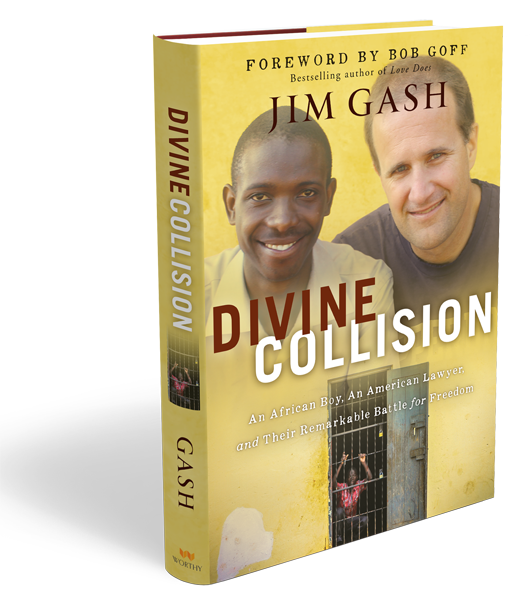
Divine Collision

There are no coincidences.  That’s the theme running through one of my favorite movies of all time, and the reason the M. Night Shyamalan/Mel Gibson film “Signs” is so high on my list.  I, too, look for God’s hand in events that others may chalk up to chance.  When unexpected events converge in my life, I see a divine collision.

When the Yates and Yates law firm/literary agency agreed to take me on as a client about six months ago, they made clear that the working title of my book, “Throwing Starfish,” wouldn’t  make the cut.  While I had grown fond of the title because of what it represented, I trusted their judgment more than my feelings.  So when we were finalizing the book proposal – the document sent to potential publishers from which they make book contract decisions – we had to come up with something new.

Over the course of a few weeks, we batted around numerous ideas and concepts.  We were looking for something that captured the combination of my story and Henry’s, that recognized God’s hand in the story told in the book, and (importantly) was unique in order to avoid confusion and any copyright issues.  Nothing seemed perfect, but since there absolutely had to be a title, and since they assured me the publisher would later play a significant role in selecting a final title, we settled on something that none of us believed would ultimately stick: “Wrongfully Accused.”  I didn’t like it because it reflected only a piece of Henry’s story, and didn’t reflect much of mine.  It also sounded like a book everyone has already read – innocent person charged with a crime he didn’t commit and struggles to get free.  That narrative is certainly part of my book, but is really only a backdrop of a much larger story.

Over the course of about two months, my agents had numerous conversations with a wide variety of publishers about the book.  Quick aside – for amateur writers to get serious consideration from established publishers without an agent is a steep climb, one I am confident I would not have been able to make.  As the time for making a decision among publishers approached, my agents provided me a status report and some guidance.  They told me that we wanted to go with a publisher who was passionate about telling the story, rather than simply comparing the terms of the offers and choosing what facially appears to be the “best” offer.  Among the important terms are (i) the advance against royalties, (ii) the percentage of the book price paid to the author, (iii) the publication date, (iv) the marketing budget allocated by the publisher to promoting the book, and (v) the number of complimentary copies the author receives.

Most consider the advance against royalties to be the most important number because it represents the minimum payment the author will receive for the book.  Here is how it works: the advance is paid to the author in three installments – 1/3 upon signing the contract, 1/3 upon final delivery of the manuscript by the author to the publisher, and 1/3 upon publication of the book.  The author will get no additional money from the publisher until the publisher recoups the advance through sales.  For example, a typical contract will involve the author getting paid 12% of the retail price of each book sold.  So if the retail price is $20, then the author gets $2.40 for each book sold.  If the advance against royalties is $24,000, then the publisher recoups the advance once sales reach 10,000 copies.  From sale 10,001 forward, the author receives $2.40 per book sold.  But, if sales never reach 10,000, the author still keeps the full $24,000.  Accordingly, the higher the advance, the higher the guaranteed payment the author receives.  But equally important, the advance becomes almost entirely irrelevant (save for the time value of money) if the author sells more books than necessary to recoup – the total royalties end up being the same.

This is why my agents strongly counseled me to go with a publisher who is passionate about telling the story – “total book sales” is ultimately a much more important number than the size of the advance.  And “total book sales” is highly dependent upon the efforts of the publisher – the more passionate the publishing team is about the book, the more books will be sold.

As chance (or something else) would have it, Jeana Ledbetter, an editor at Nashville-based Worthy Publishing, reviewed the book proposal on Worthy’s behalf.  She had previously worked with Yates and Yates at their agency in Southern California.  Fortunately, she was quite moved by it and took it to her publication board with a recommendation that they make an offer.  She later told me that she got emotional during her presentation and had a hard time making it through.

Once again, one might be tempted to chalk up to coincidence the fact that Worthy’s President, Byron Williamson, recognized my name from the several years his son and daughter-in-law had spent at Pepperdine.  Ryan and Sarah Williamson had become dear friends of ours in the late 1990s/early 2000s, and have since moved back to Nashville.  Shortly after the editorial meeting, Worthy made an offer.

A couple weeks later, when I met with my agents to discuss next steps, they suggested that we start by scheduling a phone call with Jeana at Worthy and then move forward from there.  But rather than talking via phone, Jeana asked if she could fly out to Los Angeles to meet in person instead.  That was, of course, a good sign.  Over lunch, Jeana exuded passion and commitment to the book project.  Curtis and Karen Yates peppered her with questions, and Jeana gave all the right answers.  By the end of the lunch, we had decided we were done with the selection process before it really even started.  A couple days later, we had reached a deal on all of the relevant terms.  I am not at liberty to discuss most of them, but I can say that we settled on a publication date of February, 2016, which will coincide with Henry’s three-week break from medical school so he can be out here in the United States for some launch events.

I don’t think it was coincidental that when the contract terms were finalized, I was in Angola State Prison with a delegation of Ugandans.  The staff at Angola was kind enough to print out a copy for me to sign, scan, and then send back.

Contract Signing at Angola

Because I wanted to do something symbolic in the prison to commemorate the signing of the contract at Angola, I decided to get a tattoo that reflected the miles of razor wire all around me.  The prison tattoo shop was quite accommodating, though they almost ran out of ink due to the girth of my bicep.

Commemorative Tattoo

Commemorative Tattoo I got at Angola State Prison

I should probably confess to making this part up before my mom has a heart attack.  This is the tattoo I actually got (at least as far as you know):

Mom-Banner-Heart-Tattoo

Over the next few weeks, we continued to bat around book titles.  For a while, we were on Graceful Collision, then we moved to Beautiful Collision, before ultimately settling on Divine Collision.  I am pretty sure that will be the final title.  Like most books, there will also be a subtitle – something like An African Boy, an American Lawyer, and their [adjective] Battle for Freedom.

I am honored that Bob Goff (author of NYT Best-Selling Love Does) will be writing the Forward.  We are now in the process of finalizing all of the details (cover, endorsements, etc.).  I don’t yet know when it will pop up on Amazon for pre-ordering, but I suspect that will be in November or December.  For now, the only way to pre-order the book is to contribute toward the completion of the documentary we are filming about Pepperdine’s work in Ugandan prisons.  Any donation toward the filming completion next month of at least $25 gets a free copy of the book.  A film teaser and several other clips are available at the crowd-funding site.

In other news, Henry continues to excel in medical school, though the family dispute regarding land ownership and occupancy of his family’s home has heated up and is potentially turning south.  I have hired a lawyer in an effort to prevent Henry’s mom and siblings from being forcefully removed from the land they rightfully occupy.  Prayers are welcomed for this situation to stay calm until I get back to Uganda – I am leaving one week from today for trip number 17.

Stomping Grounds

Last Friday morning, we bade farewell to the five Ugandan prison officials, none of whom had ever visited the United States before.  They were effusive with gratitude and determined to incorporate as much of what they had learned as possible.  The other five Ugandans and I (Luke returned home late Thursday night) began the day at the Louisiana State Court.  We had the opportunity to watch preliminary hearings, bail hearings, sentencing hears, and what is called “drug court.”

The New Orleans courthouse is the first in the country to be equipped with a drug testing lab inside the building.  Drug offenders in a certain category are given the opportunity to avoid prison if they can demonstrate they are able to stay clean.  This entails appearing in court regularly before the drug court judge, who gives them a much-needed dose of tough love.  The test results are delivered within minutes of the samples being given.

I understand and think I appreciate the arguments made in favor of legalization of at least some drugs.  But my opposition to such legalization strengthened significantly as I witnessed first-hand the devastation visited on the lives of those addicted to these substances.  And yes, that includes marijuana.  It is OK to disagree, but go spend an hour at the courthouse where you will see that the vast majority (95% in some jurisdictions) of crime (violent and non-violent) in our cities traces back to drugs, then we’ll talk.  (Sorry, enough preaching).

We had a chance to observe plea bargaining in action in the sentencing court, which will be a focus of the Los Angeles leg of the Ugandan delegation’s visit in the coming days.  Uganda is currently in the process of integrating plea bargaining into their criminal justice system in an attempt to address the staggering case backlog and prison overcrowding.

After a quick lunch, we were treated to tour of my old stomping grounds – the John Minor Wisdom Courthouse, which serves as the headquarters for the Fifth Circuit Court of Appeals.  The Fifth Circuit encompasses Louisiana, Mississippi, and Texas, which is why I visited this courthouse often during my 1994-95 clerkship with one of my heroes, Judge Edith Hollan Jones, whose chambers are in Houston.  After a simple phone call, she arranged the whole afternoon briefing remotely.

During the tour, we visited the extravagantly decorated and breathtakingly spacious court rooms where the appeals are argued.  Serendipitously, Judge Jones is hearing cases next week, and her name plate was already in place.  This made for a memorable photo opportunity, as I had a chance to sit in the chair of someone I greatly admire.

IMG_1276

In the en banc courtroom

In the en banc courtroom


In addition to the tour of this historic building (now 100 years old), we had a delightful meeting with Judge Steve Higginson and his four law clerks.  Judge Higginson walked through the anatomy of an appellate case from start to finish and answered numerous questions from our guests about case management at the appellate level.  The Fifth Circuit is on the leading edge of technology and provided our visitors with a vision of what the future will eventually hold for their appellate justice system.

The court clerk thereafter provided us with an extensive case management briefing and gave them each flash drives with all of the important information covered.

From the Fifth Circuit, we journeyed to the airport and boarded a plane bound for Los Angeles, where the case management study tour will resume after a weekend of rest and sightseeing.

No More Victims, and No One Dies Alone

Wednesday, our second day at Louisiana’s Angola State Prison, started off with breakfast with the larger-than-life Burl Cain – Angola’s charismatic and transformative warden.  Thereafter, we visited the prison’s vocational training centers that are set up to help the prisoners acquire a skill while incarcerated.  These include auto mechanics, auto collision repair, small engine repair (lawnmowers, engines, power tools, etc.), horticulture, eye glass manufacturing, and HVAC (heating, ventilation, and air conditioning).  The instructors are lifers with no possibility of parole.  Their students, however, include many serving shorter sentences who have been relocated to Angola so they can be trained by the lifers, most of whom have graduated from the theological seminary.  The training is so comprehensive and effective that there are more certified auto mechanics trained at Angola each year (98% passage rate) than anywhere else in Louisiana.

These lifer/teachers derive tremendous satisfaction knowing that despite their exceptionally poor choices that earned them life in prison, they have the opportunity to shape and equip others to enable them to avoid making the same bad choices after they get out.  The motto for the moral rehabilitation program is “No More Victims.”

I had to get out my hanky more than once as the head teacher in the small engine shop (who is also a Baptist minister leading his own congregation inside Angola) explained that while they cannot change their past, they do control their future.  “We help shape the men here into the kinds of fathers, brothers, sons, and husbands that we should have been.  Nothing gives us more joy than when we hear back from former students who are now living productive lives on the outside.”

In the HVAC class, the students had all kinds of questions for our Ugandan guests about life in Uganda, both inside and outside prison.  We also had a chance to visit the school where students are catching up on the basic education many of them missed out on before they were convicted.  We also stopped at the hospice care facility in the hospital/dentistry area.  Because “life means life” in Louisiana, there is a steady flow of inmates dying in prison.  The vast majority of care takers are fellow prisoners.  As the end approaches, six prisoner volunteers attach themselves to each dying inmate and serve round-the-clock, four-hour shifts, taking turns sitting, reading, and praying with the patient until he passes – “No one dies alone.”

A few days later, the inmates, guards, family, and friends are treated to a dignified service run by the inmate pastors.  The patient is buried in a beautiful, prisoner-made coffin that is brought to the outdoor funeral grounds in an ornate horse-drawn carriage.


Funeral Carriage

Funeral Carriage

And these aren’t just any horses.  The prison has more than a dozen war horses (Percherons) – the biggest I have ever seen.  They are groomed and maintained by several highly trained inmates for this very purpose.

Funeral Horses (and this prisoner was 6'8" -- at least as far as you know)

Funeral Horses (and this prisoner was 6’8″ — at least as far as you know)

The inmate carriage driver wears a tuxedo.

I can imagine right about now how one might question why so much effort and resources go toward giving the worst of the worst offenders many opportunities that those outside don’t have.  I will confess to coming into Angola with these questions.  I left Angola with none of them.

I am not a softy on crime, by any stretch, but if we truly believe in redemption (and I certainly do), then simply giving up on someone can’t be the right answer.  Moreover, the results achieved by Warden Cain and his innovative and dedicated staff simply can’t be refuted.  Incidentally, Angola receives a constant flow of prison officials from around the country (and around the world, including us Ugandans) who are starting to adopt some of the practices in other prisons.

The other important response to the resource question is that the prison raises vast amounts of money to pay for many of its programs through its semi-annual rodeo events.  Every Sunday in October and one weekend in April, the prison puts on a rodeo.  All participants are prisoners and the 6,000-seat arena is sold out every day.

Angola Rodeo Arena

Angola Rodeo Arena

Outside the arena in the carnival area, the prisoners are allowed to sell the arts and crafts they make year-round, using their own money for the supplies.  The proceeds of the rodeo allow much of what is innovative about Angola to be paid for by non-taxpayer dollars.  Accordingly, the Angola budget is not proportionately larger than other similar prisons.

Before we left Angola, we visited the rodeo and carnival grounds, and even did a little bareback horse riding ourselves.  I was able to stay on my mount for almost fifteen seconds.

Our own private Rodeo

Our own private Rodeo

Because Wednesday was employee-appreciation day, and because crawfish are now in season (who knew there was a crawfish season?), we were invited to sample Louisiana’s fifth food group at the Crawfish Boil.  I have never seen so many crawfish, and I have never seen human beings eat so many of them.

Louisiana's Fifth Food Group

Louisiana’s Fifth Food Group

Most of our Ugandan friends developed a case of the heebee geebies at the thought of eating such ugly and unfamiliar creatures.  This, from folks who devour fried grasshoppers like they are McDonald’s fries.  Go figure.

Crawfish

I felt bad that my research assistant Luke (Pepperdine ambassador and host extraordinaire) had to miss out on the second half of the day, but he had important retrieval work to do.  The night before, he and I had trekked forty minutes to the Baton Rouge airport to pick up another rental car so I could stay with the group at Angola on Wednesday while Luke drove the three hours back to New Orleans to pick up the three whose visas had been tardily issued back in Uganda.  But when the flight landed, there were only two.  The third had been turned away at the ticket counter at the Entebbe Airport before takeoff due to a ticketing snafu.  After some frantic searching and tracking, Luke was able to ascertain the lost sheep would be landing at just before midnight on a different airline.  She was quite relieved to find someone there waiting for her.

The next morning, I checked out of the wonderful and charming Bed and Breakfast where I and two of my Ugandan colleagues had stayed in neighboring St. Francisville.  The owners of The Barrow House Inn, Shirley and Chris, took such good care of us.  And the night before I left, I was humbled to learn that after reading online about the connection between Pepperdine and the Uganda justice system, they were moved to contribute a portion of what we spent on lodging toward the completion of the documentary.  Incidentally, there are new clips of the film-in-progress up on the crowdfunding site.

Later Thursday morning, our group of seven (I retrieved the other five from Angola) met up with Luke’s group of three at Louisiana’s main women’s prison, which houses 900, 140 of which are lifers.  I had no pre-conceived notions about what it would be like at a women’s prison because I don’t watch the wildly popular Netflix show “Orange is the New Black” – at least as far as you know.  Being at Angola and at the women’s prison raised up an impulse in me to buy stock in razor wire manufacturers.

Razor wire as far as the eye could see

Razor wire as far as the eye could see

While they certainly do good and important work there, we had been spoiled by what we had seen at Angola.  The warden of the women’s prison in our group left with many ideas about how to better manage her population of approximately 100 female inmates, though she lamented the relative lack of resources she had at her disposal.

In the afternoon, we met with the Governor-appointed Secretary of Corrections for the State of Louisiana, thanks to Judge Bob Downing’s good efforts.

Meeting at the Department of Corrections Headquarters

Meeting at the Department of Corrections Headquarters

This meeting was quite informative and interesting – who knew Louisiana has the highest incarceration rate of any jurisdiction in the world?  Not I.  Incidentally, Louisiana laments, rather than celebrates, this statistic.

Before turning in on Thursday evening, we returned for nearly two hours of Wal-Mart shopping.  It was supposed to be one hour, but the oft-repeated Ugandan saying rings true – “In America, you have all the watches.  In Uganda, we have all the time.”

My next post will describe a highly informative day at Louisiana State Court and at the Federal Fifth Circuit Court of Appeals.

Bringing Uganda to Angola

As discussed in the prior post about how a delegation of Ugandans ended up coming to Louisiana to visit what used to be America’s bloodiest prison, the idea for this prison visit was inspired by Bob Goff’s book, but the plan was executed by Judge Bob Downing.  The original plan was to bring five prison officials to Angola State Penitentiary for two days to study how it went from so bad to so good.

But as the project took shape, the list of Ugandan participants expanded.  The original group consisted of one prison commissioner and four prison wardens, including Wilson, the warden of Uganda’s maximum security prison called Luzira, who also features prominently in the documentary film we are in the process of making right now.  The group subsequently swelled to include the Solicitor General of Uganda, a senior advisor in the Ministry of Justice, the lead legislation drafter for the country, the Deputy Director of Public Prosecution (#2 in command at the prosecution authority), and the lead mover and shaker on the Plea Bargaining Task Force.

At some point, I realized the group was too large for me to handle in one 12-passenger van, so I conscripted my research assistant, Luke Landers, to come with me to drive a second car and help with logistics.  He has been fabulous.

All were set to arrive on Sunday on two flights, thirty minutes apart.  And then they weren’t.  Due to some bureaucratic snafu, the US Embassy failed to issue visas for three of them on Friday, so they couldn’t leave the country on Saturday.  Fortunately, none of those left behind were prison officials.  And then there were seven.

And then one flight was delayed, so they landed at the same time.  In different terminals.  Fortunately, Luke was with me, so he greeted one set, and I greeted the other.  They were tired, but excited to be in the US.  For the prison officials, this was their first visit.

On Monday, we saw the “sights” of New Orleans – Mississippi River was hit; the French Quarter a bit less so, though we did enjoy some beignets.

At the Might Mississippi

At the Might Mississippi

From New Orleans, we drove north through Baton Rouge up to Angola (almost three hours away), where the five prison officials are staying in the guest quarters.  We hit Chick-Fil-A, McDonalds, and Best Buy on the way.  All went over well.

Luke with the Ugandans for their first Chick-Fil-A Experience

Luke with the Ugandans for their first Chick-Fil-A Experience

We were welcomed warmly on Monday evening at Angola and got everyone situated.  The others of us are staying at bed and breakfast about 45 minutes away.

Tuesday was quite eye-opening.  The prison complex itself is the size of Manhattan.  Literally – same number of square miles.  It is surrounded on three sides by the mighty Mississippi and the virtually impenetrable Tunica Hills on the fourth side.  And there is lots of razor wire.  Lots.

Warden Burl Cain does things the right way – he set us up with some great and knowledgeable hosts who gave us tours of death row (sobering), the current and former executions (a bit spooky), and virtually the entire complex.  We met dozens of prisoners who had earned the right through good behavior to interact with visitors.  The highlight of the tour was a visit to two churches, which had been built by prisoners, for prisoners.  One was built in the shape of the Alamo.  But the highlight of the day was a two-hour conversation with about eight lifers.  Each of them had completed a four-year seminary program through the New Orleans Baptist Theological Seminary, and each of them led an inmate church or program.

IMG_1186

IMG_1209

Most had been in for more than 20 years, and all of them seemed completely normal – like someone I would expect to encounter in daily life on the outside.

Their stories of transformation and acceptance of both God’s love and their own circumstances shredded me.  At the end, I asked one of them aptly named Paul to pray for our group.  Tears streamed down my face as he blessed and encouraged our Ugandan friends with his whole heart.  Our hope is to replicate in Uganda to some degree the theological training happening at Angola.  Warden Cain (and others) attribute the huge turnaround at Angola to the fact that the dozens and dozens of lifers who are theological trained and equipped become the leaders and mentors of the other prisoners.  There is nothing more effective than prisoners leading other prisoners toward a better life of better choices and spiritual wholeness.  They live in and among the other prisoners, and the results are staggering.

I left today with a better understanding of just how much of my faith and security I take for granted.  The Ugandans left today with firm resolve to set up a similar program at the maximum security prison in Uganda.  Please pray for their success.

We will spend Wednesday back at Angola delving deeper into the re-entry programs that have been so successful, which are primarily led by the lifers-turned-pastors.

A Tale of Two Bobs and Two Harriets

A caterpillar escapes its cocoon in San Diego, causing a butterfly to flap its wings in Baton Rouge, which changes the passenger list of a plane departing Uganda.  Two Bobs changed the lives of two Harriets.

Why?  Because both Bobs understand that Love Does, and both Harriets want to transform their country.

One of my heroes is San Diego lawyer Bob Goff.  He is primarily responsible for my life taking a sharp turn five years ago into the southern hemisphere.  Bob wrote a book called Love Does in which he tells lots of funny, interesting, and incredible stories of love in action.  About a year ago, another Bob read Love Does in his men’s group and was less than convinced Bob Goff was for real.  Retired Louisiana State Court Judge Bob Downing was more than a little skeptical about some of the stories he read, particularly those having to do with Bob’s work in Uganda.

After discovering a connection between the Ugandan work described in Love Does and Pepperdine Law School, Judge Bob called Pepperdine and was transferred to me.

“I wanted to let you know that Bob Goff appears to be taking credit in his Love Does book for the work you are doing in Uganda,” he said.

“Not as much as he should be,” I responded.

Over the next forty-five minutes, Judge Bob and I chatted about Bob Goff, Uganda, and the practice of law.  We became fast friends.  At the end of the call, he said, “Well, I know what I am eating for lunch tomorrow at the men’s Bible study.”

“Oh yeah?  What’s that?”

“Crow.  I will be admitting I was wrong about Bob Goff.”

Over the next few months, Judge Bob and I e-mailed and chatted periodically.  After my return from Uganda last July when I spent a bunch of time in a Ugandan maximum security prison, Judge Bob asked whether I’d ever thought about bringing prison officials out to the United States for training and idea exchanges, like we do with the Ugandan judges. “I have spent some time working with the folks at what used to be the bloodiest and most awful prison in American – Angola State Penitentiary just north of Baton Rouge.  The warden there, Burl Cain, is doing some phenomenal things and it is one of the best prisons in America now.”

“I haven’t actually ever thought about it,” I confessed.  “That sounds like a great idea, but I wouldn’t know where to start arranging it or raising funds to make it happen.”

“If you think it is a good idea and if you think you can get the Ugandans to come, I’ll work on the other aspects,” he replied.  “In the meantime, I am going to send you the book written about Warden Cain and Angola.  Read it and let me know what you think.”

A couple days later, “Cain’s Redemption: A Story of Hope and Transformation in America’s Bloodiest Prison” arrived.  I was blown away by the work the warden had done.

A couple months later, Judge Bob had secured a grant from his church (First Presbyterian of Baton Rouge) to pay for five prison officials to come, and had secured permission from Angola for a group of Ugandans to spend a couple days there.

A couple days ago, I flew to Louisiana to greet this group of Ugandans at the New Orleans airport as they stepped off the plane.

Two of them are named Harriet.

Jim and Bob Downing Conspiring to Assist the Ugandan Prison Authority

Jim and Bob Downing Conspiring to Assist the Ugandan Prison Authority

Judge Bob with the Five Ugandan Prison Officials he Brought to Louisiana

Judge Bob with Ugandan Prison Officials he Brought to Louisiana

More tomorrow on what promises to be a life-changing trip for all of us.

A Book and A Film

The past several weeks have been kept me on pins and needles as my agents have been chatting with a number of publishers about the book I have been working on for past five years.  I have previously written about how much I learned in the writing and editing process in Confessions of an Amateur Writer, Part I, Part II, Part III, and Part IV.

Over the past week, we have been narrowing our conversations and negotiations.  And yesterday, we reached an agreement with what we believe will be the perfect publishing company for the book.  So, after literally thousands of hours of writing and editing, I am no longer an “amateur” writer.  After we sign the contract later this week, I will be able to provide more details about the plans for the book.  It is scheduled to hit bookshelves at a store near you in early February of 2016.  The original title, Throwing Starfish, has fallen by the wayside; I will be working with the editorial team over the next few weeks to come up with the final title.

Thanks to all who have encouraged and prayed for me along the way – you have my profound gratitude.

In other exciting news, we are finally able to share the two-minute teaser for the documentary film that we started last summer and hope to complete this next summer.

We are currently in the process of crowdfunding the final budget for completion and distribution.  As I have mentioned previously, the production company is Nashville-based Revolution Pictures, the director is Andy Reale, and the cinematographer is John Pope.  John’s last documentary won the Grand Prize and Audience Award at the Sundance Film Festival, so we are very excited about the cinematography and story.

If you want to see the teaser, click on the image below.  Also, if you, or someone you know, want to help us finish the film, we would be grateful for your support.  Check back at the crowdfunding site each week for new clips and behind-the-scenes footage of this story about Pepperdine’s impact on Uganda’s criminal justice system, told through the eyes of Pepperdine law students, a former juvenile prisoner who is now in medical school, and Uganda’s leading judicial officers.

remand-video screenshot image

Et Tu Rwanda?

I was originally schedule to leave Uganda Friday night after eight days on the ground in Africa.  Early last week, however, my Thursday meeting in Kigali, Rwanda was pushed back to the following Monday (yesterday) to enable Uganda’s Principal Judge to attend the meeting.  This delay served to calm (somewhat) my usual frenetic pace while on the ground in Uganda.  I enjoyed a Saturday evening with the family of a member of Uganda’s Law Reform Commission who is, more than anyone, driving the logistical bus in Uganda for the reforms being implemented.  I also had a chance to worship Sunday morning with some friends from Sixty Feet, an American non-profit caring for Ugandan juvenile prisoners and orphans.

In Rwanda early Monday afternoon, I was once again reminded of the surprising contrast between life in Kigali and life in Kampala – separated by just forty minutes by air.  Kigali more closely resembles Western Europe than Eastern Africa – there are clean, wide, pothole-free roads lined with manicured vegetation, functioning (and obeyed) traffic signals, and modern buildings and shops.  Rwanda has recovered well from its devastating genocide in 1994.  Critics contend, however, that the economic and political stability Rwanda enjoys comes at the price of free speech and political dissent.

A few minutes earlier, I’d been greeted by at the airport by International Justice Mission’s former Kigali field office director, Lane Mears, who now works for USAID, a funding arm of the US State Department.  (Before I left Kampala that morning, I had a good meeting with IJM’s Kampala field office director, Kathryn Wilkes, about potential further collaboration between Pepperdine and IJM).  I’d invited Lane to attend the meeting between the Ugandan and Rwandan delegations so he could connect more closely with the players and assist in evaluating the whether Rwanda should consider following Uganda’s lead.

Uganda’s delegation consisted of Justice Bamwine, who leads the High Court of Uganda (trial court) as the Principal Judge; Andrew Khaukha, who serves as the Secretary of the Plea Bargaining Task Force chaired by Justice Bamwine; Betty Khisa, who serves as Deputy Director for Uganda’s Department of Public Prosecutions; and me, in my role as Specialist Advisor to the High Court of Uganda and meeting convener.  (Incidentally, Betty is the lawyer against whom I argued Henry’s appeal more than two years ago.  We’ve since become friends and she is going to inquire this week about the status of the ruling in Henry’s case).

Chief Justice Sam Rugege headed the Rwandan delegation.  When the genocide occurred 21 years ago, Justice Rugege was teaching law in South Africa.  At the urging of Rwandan President Paul Kagame, Justice Rugege returned home to serve as Rwanda’s Deputy Chief Justice to help stabilize the country’s judicial system.  About four years ago, he became Chief Justice.   For the past half-dozen years, Justice Rugege has welcomed two Pepperdine summer interns each year into his judicial chambers, and has been a good mentor for our students.

Also on the Rwandan side: the Prosecutor General (who will have a Pepperdine intern this summer); the President of the High Court (counterpart to Principal Judge Bamwine); the Solicitor General; the Deputy Minister of Justice; the Inspector General of Courts; the Inspector General of Prosecutions; the Inspector General of Police; a couple High Court Justices; the Commissioner and Deputy Commissioner of Prisons; and a few others.

Chief Justice Rugege and Principal Judge Bamwine at the head of the table

Chief Justice Rugege and Principal Judge Bamwine at the head of the table

After warmly welcoming us, Chief Justice Rugege turned the floor over to “us Ugandans.”  I started off with a thirty-minute overview of plea bargaining concepts and the historical events that put Uganda on the path to plea bargaining.

Rwanda Meeting #2

The Principal Judge followed me, providing further depth to Uganda’s decision-making process and plea bargaining adaptations.  Andrew then concluded with a report of statistics, successes, and lessons learned along the way.  Our presentation last about two hours, and was followed by a lively question and answer session.  One of the obstacles in Rwanda’s path to plea bargaining is its Civil Law heritage.  Unlike the United States and Uganda whose Common Law legal systems trace their roots back to the British, Rwandan’s system derives from the French.  In fact, Rwandan laws are translated into three languages – Kinya-Rwandan, French, and English.  Unlike Common Law countries, Civil Law countries combine, to a large degree, criminal and civil cases such that a murder trial would also involve a component of monetary damages sought by the victim’s family.  (Those would be totally separate in the United States).  I suspect our students serving as interns in Rwanda summer will be called upon to assist the Rwandese in evaluating whether plea bargaining would be an appropriate way to enable Rwanda to reduce the criminal court backlog and prison congestion.

Group Photo after Meeting

Group Photo after Meeting

All in all, the meeting was quite productive and I look forward to seeing where it leads.

Once I am back and settled in the US later this week, I will update where things stand in my quest to lose my “amateur” writer status.

Expecting the Unexpected

Since arriving back in Kampala after a weekend visit with Henry at his medical school, I have been running around town for various meetings.  My initial itinerary called for me to leave tonight, but I have come to expect the unexpected in Uganda.  Consequently, I wasn’t too surprised when my return trip was delayed by three days.  I now head home on Monday – out of Kigali, Rwanda.

Monday through Thursday involved a series of successful and encouraging meetings.  My meeting at the US Embassy with a Ugandan professor (employed by the Embassy) and American diplomat went quite well.  I appreciated the opportunity to share all of what Pepperdine is doing with the Ugandan Judiciary, and they are eager to find ways to work together in the future.  They had heard about some of our work from various Ugandan officials and were glad to finally connect.  I suspect I will be meeting with the Embassy on each of my return trips in the future.

My meeting with the newly appointed Chief Justice of Uganda, Bart Katureebe, also went quite well.  A few years ago, one of our students had interned for him for the summer, so he had a general idea of Pepperdine’s involvement with the judiciary as a whole.  He has accepted our invitation to come to Pepperdine this next fall to further deepen the relationship between our respective institutions.  His past experience in all three branches of the government — Member of Parliament, Attorney General, and Supreme Court Justice – makes him an ideal candidate to succeed retired Chief Justice Benjamin Odoki.

I also had productive meetings with both the Solicitor General and the Chief Registrar of the High Court of Uganda, both of whom are coming to Pepperdine next month for a study tour focusing on case management structures, which is aimed at improving the efficiency of work flow in both the civil and criminal realms in Uganda.

We are still “patiently” awaiting the ruling on Henry’s appeal (25 months and counting), and I met with the lawyer who assisted me with the case to discuss if any avenues exist to expedite the ruling.  We also discussed the seemingly intractable land battle Henry and his family are embroiled in.  I was encouraged to learn a few aspects of Ugandan land law that may provide a roadmap toward resolution.  I anticipate hiring him soon to represent Henry’s family’s interests.

For the past several years, I have been communicating periodically with the Chief Justice of Rwanda, mostly about our student internships with his court each summer.  Recently, however, our discussions have turned toward the possibility of Rwanda evaluating some of the criminal justice reforms with which we are assisting Uganda.  Those discussions have led to a meeting that will now take place this coming Monday (necessitating my unexpected delayed return).  There will be four of “us Ugandans” (including the Principal Judge (head of the trial court)) meeting in Kigali, Rwanda with about a dozen of the top judicial, prosecutorial, police, and prison officials in Rwanda about possible next steps for Rwanda.  I am excited about the prospect of becoming more deeply involved in assisting Rwanda, if they decide t to proceed.  It should be an interesting meeting.

Further unexpected was my debut on Ugandan television, as I was captured in a clip filmed at the plea bargaining conference last week.  Even more unexpected was the startling headline accompanying the clip – “Principal Judge Opposes Introduction of Plea Bargaining.”  Nothing could be further from the truth – the PJ is the staunchest supporter of plea bargaining, as is clear from the clip itself: https://www.youtube.com/watch?v=YgT9GJb7RLQ.  Featured in the clip is one of the prisoners our team helped secure a plea bargain last summer.

More after Monday’s meeting in Rwanda.

A Different Kind of Commission

Commissioning Prayer

Commissioning Prayer

Pepperdine is a different kind of place to study law than most, as evidenced by the annual Commissioning Ceremony that takes place for those graduates who attend the weekly Bible study at the Gash home each week.  I was heartbroken that my responsibilities in Uganda necessitated my absence from this culminating event.  My wife, Joline, was kind enough, however, to read for these graduates a few words I prepared for this occasion:

“While my body is in Uganda, my heart is with you right here, right now. I eagerly await my return to Pepperdine to celebrate with you in person, your graduation.

I will swell with pride and emotion as Dean Sturgeon reads your name in the book of graduation before you walk across the stage. I will do my best not to cry, but no promises.

I am so proud of you.

As you know, God has been reading your name in the book of life, and (as Bob Goff is fond of saying) Jesus is carrying a picture of you around in his wallet. He is quite proud of you as well.

But not for graduating from law school.

His pride in you is because of your steadfastness in the face of hardship, your faithfulness in the face of fear, and your love and support for the brothers and sisters here with you tonight as you walked this path together.

Over the course of your three years at Pepperdine, you have attended classes, briefed cases, written papers, presented arguments, and taken exams. Some of you liked law school. A few of you loved it. All of you have loved each other. You sang together, studied together, prayed together, played games together, walked beside each other, and at times, carried one another. Through it all, you have inspired your professors and you have shown your classmates what it looks like to follow Jesus in a community.

Over the course of this year on Wednesday nights, we have collectively pondered what it means to be powerful in Christ amidst our weakness. You have led worship, led prayers, led our thoughts, and led from your seats as the 1Ls and 2Ls watched your consistency and faithfulness. Some of you have excelled at the game of law school, and some of you have simply survived. But each of you in your own way has modeled perseverance and grace and joy in this journey.

Some of you have a clear vision of what the next step will be occupationally. Others are still waiting for God to reveal that. We pray that He will reveal that soon, but we also pray for patience as God unfolds His plan in His time.

But I do not believe that your first job, your second job, or your last job is your calling. The calling you have received is to live life overflowing with the joy that comes from being a child of God, a follower of Christ. You are a vessel, made by the hand of God, made in the image of God, made to reflect the love of the Son of God.

The context in which you live out this calling is but a backdrop for the content you pour into those around you.

My prayer for you as you receive this commission is:

That you, though hard pressed on every side by the stresses of your chosen profession, will not be crushed.

That though you are at times perplexed by the vagaries and ambiguities of the law, will not be in despair.

That though you may be persecuted for the stands you take, for the people you represent, for the God you serve, you will never feel abandoned.

And that even when you stumble in your cases, in your deals, in your relationships, and in your daily walk – when you feel struck down, that the Spirit of God that lives within you will never, ever be destroyed.

We will miss you, but a part of you will always be here among us each week we gather as law students, law professors, and brothers and sisters in Christ. Come back and see us often.”